
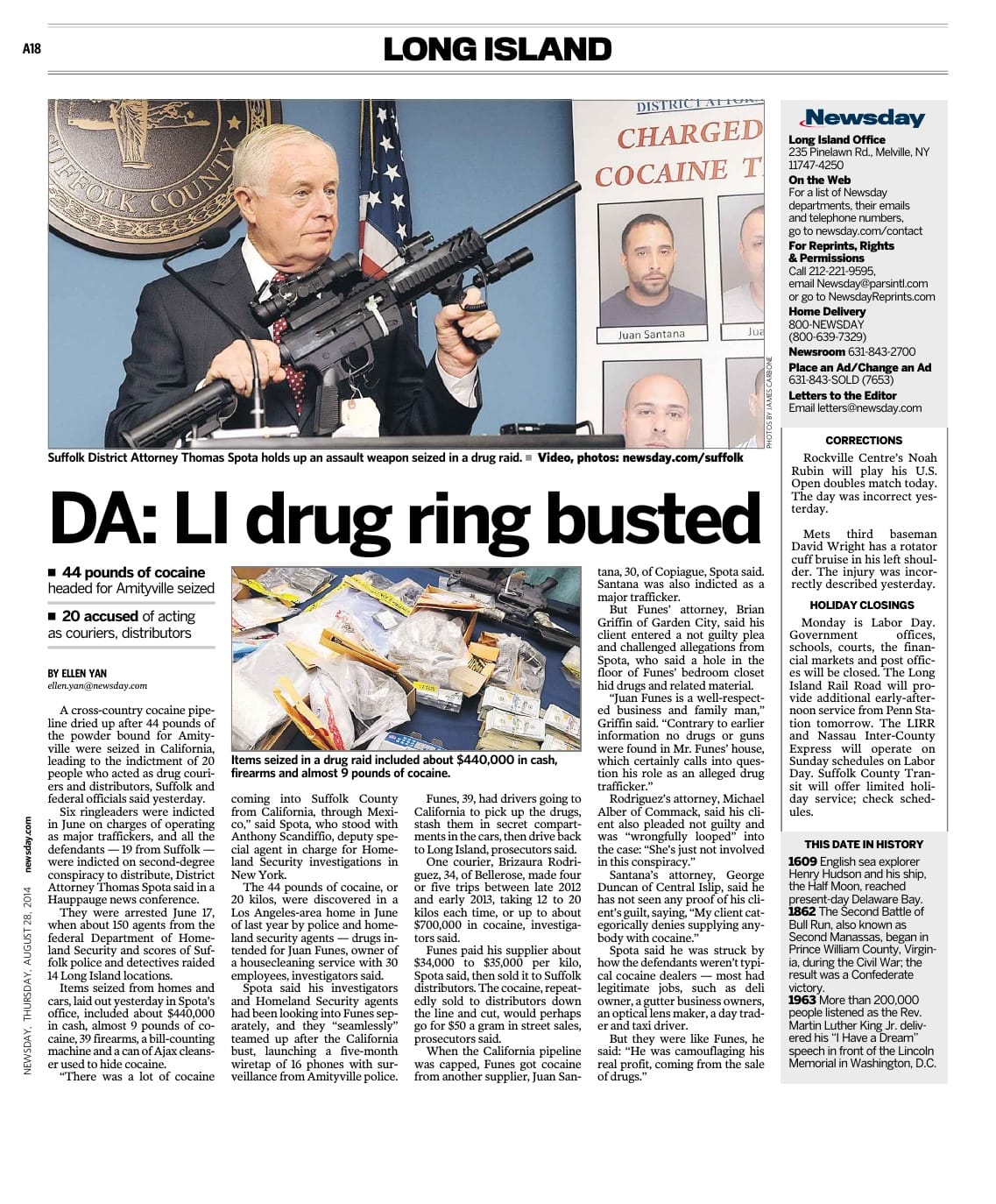
DA: LI drug ring busted

Inside the Long Island Cocaine Ring Investigation.
A California seizure opened one end of a cross-country supply line. Five months of intercepted communications across 16 phones, surveillance, vehicle and travel analysis, coordinated searches, and person-by-person evidence development exposed the Long Island end. Christopher Rizzi served as lead investigator and wiretap coordinator.
This account separates allegations reported at the charging stage from seizures and other events described in contemporaneous public records. Rizzi’s role is based on his firsthand account. The narrative does not imply that one investigator personally caused every arrest, charge, or seizure.
The takedown was the public ending. The investigation began nearly 3,000 miles away.
Newsday reported that authorities traced a cocaine pipeline from Mexico through Southern California and into Suffolk County. A Los Angeles-area seizure of 20 kilograms – about 44 pounds – provided the opening, but it did not identify every courier, recipient, vehicle, storage point, or local distributor.1
The task was to convert a distant seizure into a reliable account of a network. Investigators had to identify speakers, attribute phones, follow vehicles, compare intercepted language with physical events, and keep the evidence connected to the correct person. An association could generate a lead; it could not substitute for proof.
The reported scale was substantial: 16 intercepted phones, a five-month wiretap, coordinated searches, approximately 150 participating agents and officers, cash, firearms, cocaine, and evidence recovered from multiple places.13
Public accounts identified Funes as an alleged central supplier whose Amityville residence was said to be the intended destination of the California shipment.
Newsday reported that investigators alleged Santana became another source after the California pipeline was disrupted.
Authorities alleged that kilogram quantities traveled east in cars and sport-utility vehicles equipped with concealed compartments.
The alleged network included people assigned different roles. The evidence had to distinguish supply, transportation, storage, distribution, and association.
Rizzi served as lead investigator and wiretap coordinator, organizing intercepted communications and coordinating their comparison with surveillance and known events.
The enforcement action brought together Suffolk County investigators, Homeland Security Investigations, police personnel, and supporting teams.
A seizure became a map of calls, vehicles, trips, money, and people.
The public record describes an investigation developed through a California seizure, alleged courier travel, a change in supply, court-authorized interceptions, surveillance, and coordinated enforcement. Each layer answered a different question.
Twenty kilograms had been intercepted before they reached Long Island. Investigators still had to determine who expected the shipment, how earlier loads allegedly moved, who handled them after arrival, and whether the same network continued through another source.
Twenty defendants were reported in a case built before the cameras arrived.
Newsday’s August 2014 account described 20 people accused of acting as couriers or distributors in a cross-country cocaine pipeline. Six alleged ringleaders faced operating-as-a-major-trafficker charges, while conspiracy charges reflected the broader distribution theory.1
The announcement displayed the visible results: seized cocaine, cash, firearms, a money-counting machine, and other items. But the harder work preceded the display. Investigators had spent months deciding which phone, vehicle, trip, meeting, and location belonged to which person.
Twenty kilograms allegedly headed for Amityville never completed the trip.
ICE reported that a Los Angeles HSI task force seized 20 kilograms of cocaine believed to be destined for Funes’s Amityville residence. Authorities alleged that the cocaine originated in Mexico, reached Southern California, and was concealed for transport east.3
The seizure provided a lead, not a completed Long Island case. It did not by itself establish who had arranged earlier trips, which people expected the drugs, where loads were stored, or how the cocaine moved into local distribution. Those questions required a longer record.
Repeated cross-country trips created a trail of quantities, prices, vehicles, and people.
The preserved Newsday article reported that one alleged courier made four or five California-to-Long Island trips between late 2012 and early 2013. Investigators alleged that individual trips carried between 12 and 20 kilograms and could represent as much as approximately $700,000 in cocaine at the reported wholesale price.1
Newsday reported kilogram prices of approximately $34,000 to $35,000, with cocaine then moving through Suffolk County at a much higher per-gram street value. Those figures helped explain the alleged economic structure, but money estimates still had to be connected to a particular shipment, source, and participant.
Authorities alleged that cars and sport-utility vehicles contained concealed compartments, or traps. A vehicle could connect travel and possession, but investigators still had to establish who controlled it, who knew about the compartment, and which trip corresponded with which communication.
Sixteen intercepted phones had to become a reliable chronology.
Newsday reported that the investigation used a five-month wiretap involving 16 phones. Rizzi served as wiretap coordinator, a role requiring the team to organize calls by date, time, line, speaker, subject, and developing event – then compare the language with surveillance, vehicle information, travel, meetings, and searches.
A call could suggest a delivery or payment without establishing that either occurred. Call-detail records could help establish timing and contact patterns; surveillance could test whether a vehicle or person appeared where the interpretation predicted. Neither discipline should be treated as self-proving.
Speaker attribution was especially important. If a phone changed hands, if people used nicknames, or if coded language shifted, the case record had to show why the team attributed a conversation to a particular person.
After the California route was disrupted, investigators alleged another supplier appeared.
Newsday reported that after the California pipeline was capped, investigators alleged Funes obtained cocaine from Juan Santana of Copiague. Santana was also charged as a major trafficker.1
That alleged change mattered because it tested whether investigators were looking at one shipment or a continuing distribution structure. A new source could alter phone usage, meeting locations, vehicle patterns, pricing, and downstream relationships. The chronology had to account for the transition rather than force all activity into one unchanging model.
Months of attribution converged across Long Island.
Newsday described approximately 150 agents and officers participating in raids at 14 Long Island locations. The ICE HSI account described 16 search warrants in the broader joint operation. Those formulations identify different aspects of the enforcement action and are preserved according to their respective sources.13
The reported seizures included approximately $440,000 in cash, nearly nine pounds of cocaine during the raids, 39 firearms, a money-counting machine, and an Ajax cleanser can that authorities said was used to conceal cocaine. The earlier California seizure accounted for approximately 44 pounds.1
Multi-location enforcement creates a separation problem. Evidence recovered from one residence, vehicle, office, or person cannot be casually attributed to another. Search teams, evidence personnel, analysts, and case investigators must preserve location, custodian, sequence, and individual relevance.
Newsday also quoted defense attorneys disputing aspects of the government’s account, including the meaning of recovered items and whether drugs or firearms were found at particular locations. Those positions became part of the public record surrounding the announced charges.1
What a lead investigator and wiretap coordinator must protect.
The enduring skill is disciplined reconstruction: keeping calls, records, surveillance, vehicles, locations, seizures, and people in a chronology that can be tested.
That work now informs complex litigation support, Title III review, CDR analysis, surveillance review, and investigations where the difference between association and attribution matters.
Identify the speaker before interpreting the call.
Attribution should rest on context, records, observed events, and repeatable reasoning.
Use physical events to test communications.
A meeting, trip, vehicle, search, or delivery can corroborate – or contradict – an interpretation.
Separate every person and location.
Evidence from simultaneous searches must remain tied to its actual source and custodian.
Preserve the procedural stage.
Reported allegations, seizures, charges, defenses, pleas, and adjudicated outcomes are not interchangeable.
Read the reporting behind the story.
These records document the California lead, alleged supply route, wiretap, coordinated searches, seizures, and announced charges.

DA: LI drug ring busted
The preserved newspaper page reports the California seizure, alleged courier trips and prices, 16 intercepted phones, coordinated raids, charges, seizures, and defense responses.

Authorities bust cocaine ring on Long Island
The related coverage addresses the arrests, searches, reported cash, firearms, and cocaine seized.

The federal account of the joint operation
The ICE HSI account describes the California seizure, concealed vehicle compartments, search warrants, joint enforcement, and alleged distribution network.
What supports each part of the account.
- Contemporaneous newspaper account. Newsday, “DA: LI drug ring busted,” August 28, 2014. The preserved page reports the alleged supply route, quantities, prices, wiretap, enforcement action, seizures, charges, and defense responses.
- Related press coverage. New York Post, “Authorities bust cocaine ring on Long Island,” August 28, 2014, preserved through RPI’s related historical post.
- Official federal account. U.S. Immigration and Customs Enforcement, Homeland Security Investigations, release concerning the Suffolk County cocaine-ring investigation. The release describes the California seizure, concealed compartments, warrants, and joint operation.
- Firsthand role account. Christopher Rizzi supplied the role information used here: lead investigator and wiretap coordinator. That account does not replace the charging or disposition records.
Wiretap evidence becomes useful when it is organized around people and events.
Royal Palm Investigations supports counsel with communications review, CDR analysis, surveillance analysis, chronologies, and person-by-person evidence organization in serious criminal and civil matters.