Feds: Six Charged in Long Island ‘Birth Tourism’ Scheme

Inside the Long Island Birth-Tourism Investigation.
A Smithtown clerk’s observation led investigators from one house to Turkish-language social-media recruitment, seven alleged birth houses, travel and housing records, intercepted communications, Medicaid claims, bank activity, and a federal fraud and money-laundering case. Christopher Rizzi served as wiretap coordinator.
The indictment and initial news reports are described as allegations at the charging stage. Later facts concerning Ibrahim Aksakal are tied to his guilty plea and sentencing record. The women who used the service were not charged in the cited public accounts, and the children’s citizenship was not revoked.
Five pregnant women at one house opened a case that crossed languages, borders, records, and agencies.
Suffolk County officials said an unidentified Smithtown clerk became suspicious after seeing five pregnant women in the same house over a short period. The observation did not prove a crime. It gave investigators a starting point: who controlled the property, why the women were there, how they arrived, who paid, and what representations had been made.1
The investigation expanded into Turkish-language Facebook pages, travel and visa information, housing, aliases, Medicaid records, financial accounts, and communications. Federal prosecutors later alleged that 117 women gave birth to 119 children through the operation and that Medicaid paid more than $2.1 million for their care.14
The range of evidence made this different from a conventional narcotics or organized-crime case. The alleged conduct sat at the intersection of marketing, identity, immigration representations, health-care benefits, money movement, and physical housing.
Officials said five pregnant women seen at one house prompted a tip and further inquiry.
Aksakal later pleaded guilty to conspiracy involving health-care and wire fraud and was sentenced to 27 months in federal prison.
Federal prosecutors charged four Turkish nationals and two U.S. citizens with offenses involving health-care fraud, visa and wire fraud, and money laundering.
Authorities said two Facebook pages promoted an organized path for pregnant Turkish women to give birth in the United States.
As wiretap coordinator, Rizzi helped the team identify speakers, organize intercepted calls, and connect communications to records and physical events.
Suffolk investigators worked with Homeland Security Investigations, state investigators, and federal prosecutors as the evidence crossed jurisdictions.
An alleged service business left digital, financial, travel, benefit, and housing records.
The public record shows how a local lead developed into a federal case. Each source type answered a different part of the alleged scheme, and none could responsibly replace the others.
Prosecutors alleged that the operation did not merely house women who happened to be pregnant. It marketed a coordinated package – travel, lodging, transportation, benefit enrollment, and delivery in the United States – while allegedly instructing participants to conceal facts from government agencies.
Twenty-seven months closed one defendant’s public case, not the entire investigation.
In March 2022, U.S. District Judge Joanna Seybert sentenced Ibrahim Aksakal to 27 months in prison. Newsday reported that he had already spent approximately 15 months in custody. The sentence also included approximately $1 million in restitution and $400,000 in forfeiture.3
Aksakal had pleaded guilty to conspiring to commit health-care and wire fraud. The five co-defendants’ cases were described as ongoing in the source available at the time. That procedural distinction matters: one defendant’s plea and sentence did not establish a disposition for every charged person.
The defense presented mitigation concerning Aksakal’s background, physical abuse in Turkey, his life in the United States, remorse, and willingness to accept removal after imprisonment. The government described the offense as an abuse of health-care and immigration systems. The court imposed sentence after hearing both accounts.3
A clerk’s observation had to be tested against records, not treated as proof.
Suffolk officials said the case came to light after a clerk saw five pregnant women at the same Smithtown residence over a short period. Investigators still had to establish who owned or controlled the property, whether other houses were connected, and whether the pattern reflected lawful temporary housing or part of a larger alleged fraud.1
That distinction illustrates source discipline. An observation can justify inquiry. It does not establish intent, a financial arrangement, a false statement, or a participant’s knowledge.
Two Turkish-language Facebook pages allegedly offered an organized route to giving birth in America.
Newsday reported that investigators identified pages whose English titles roughly translated to “Giving Birth in America” and “My baby should be born in America.” Officials said the pages promoted the opportunity to have a child in the United States and used language describing future citizenship and minimal costs.1
One page allegedly claimed the organization had arranged more than 800 births. That advertising statement is different from the charged case record, which identified 117 women and 119 children. The two figures should not be merged.
The pages allegedly described housing in an “up-kept” two-story home in an unidentified community approximately 45 minutes from New York City. The literature said the five bedrooms were named after New York City boroughs. These details gave investigators language, images, claims, and locations that could be tested against actual housing and travel records.
Social-media investigation in a case like this requires preservation of the page, language, date, account identity, edits, audience, and the real-world event allegedly connected to the post.
The alleged operation extended through residences across Suffolk County.
Public accounts identified seven alleged birth houses in communities including West Babylon, Center Moriches, Dix Hills, East Northport, East Patchogue, and Smithtown. Investigators had to connect each address to the correct lease, owner, resident, arrival, payment, and defendant rather than treating all houses as interchangeable.1
Federal prosecutors alleged that participants arranged lodging and transportation for women who entered the United States on tourist or business visas. Officials said the women were instructed to conceal their pregnancies when they entered the country. Those claims required comparison of communications with travel dates, applications, housing, and statements made to government agencies.
The fee allegedly covered housing, transportation, and “insurance.”
Newsday reported that pregnant women were promised a package costing approximately $7,500 to $10,000. The marketing allegedly described coverage from housing and transportation through insurance. Prosecutors said the “insurance” was fraudulent Medicaid enrollment.1
Officials alleged that the defendants collected approximately $750,000 in fees, with much of the money placed in Turkish bank accounts. That allegation had to be developed separately from the Medicaid claim. A client payment and a government benefit are different transactions, supported by different records and involving different questions of knowledge and intent.
The financial record therefore required more than matching round numbers. Investigators had to identify the account holder, payer, date, beneficiary, stated purpose, corresponding travel or housing event, and any later movement of funds.
Medicaid records allegedly showed more than $2.1 million paid for 119 births.
Federal prosecutors alleged that 117 women gave birth to 119 children and that Medicaid paid more than $2.1 million for their care. Officials said the women were generally middle- or upper-middle-class professionals, including doctors and flight attendants, rather than indigent applicants.14
The women returned to Turkey and were not charged in the cited accounts. Officials also said the children were expected to retain their U.S. citizenship under existing law. The criminal allegations focused on the organizers and the alleged fraud, not on revoking citizenship from the children.
Benefit records can show enrollment, claims, dates, providers, and amounts. They do not alone establish who supplied information, what the applicant was told, or which defendant knew a representation was false. Those questions required communications and individual attribution.
Intercepted calls had to be connected to names, aliases, travel, houses, and money.
Rizzi served as wiretap coordinator, helping the team identify speakers, organize intercepted calls, and connect those communications to the records and events developed across the broader investigation.
The same person might appear under a legal name, nickname, social-media identity, telephone number, account, address, or travel record. Investigators had to show why those identifiers referred to the same individual. Translation added another layer: the meaning of Turkish-language communications had to be preserved without stripping away context.
A call suggesting an arrival, payment, application, or move between houses gained significance only when the surrounding records supported it. This is the same discipline applied in complex litigation-support investigations: conclusions remain tied to the source and the person.
Six defendants faced allegations involving health-care fraud, visa and wire fraud, and money laundering.
The initial Newsday account identified four Turkish nationals and two U.S. citizens. It reported that two defendants were ordered detained, two were released on $50,000 bond, and one was placed on home detention with electronic monitoring pending a further appearance. Those were pretrial conditions, not findings of guilt.1
The charges carried potential penalties of up to 20 years on some counts. At indictment, all defendants remained presumed innocent. Aksakal’s later guilty plea established his own admitted conduct and included an agreed forfeiture of $397,500; his 2022 sentence then added the court’s final public disposition for him.23
What a multi-agency fraud case requires.
This investigation required communications analysis, identity resolution, travel chronology, housing records, benefit claims, bank activity, social-media preservation, translation, and federal coordination.
The lesson is not that every fraud matter follows this pattern. It is that different record systems must remain source-specific while being organized into one testable chronology.
Resolve aliases before connecting conduct.
Names, telephone numbers, accounts, social profiles, addresses, and travel records must be linked by evidence.
Preserve language and context.
Translated communications should retain the original source, date, speaker analysis, and surrounding events.
Separate transactions and programs.
Private fees, bank transfers, benefit claims, housing payments, and travel expenses answer different questions.
Track every defendant separately.
A plea or sentence for one person does not establish the outcome of another person’s case.
Read the record behind the story.
The preserved reporting and official federal release document the charging-stage allegations, guilty plea, forfeiture, restitution, and sentencing record.
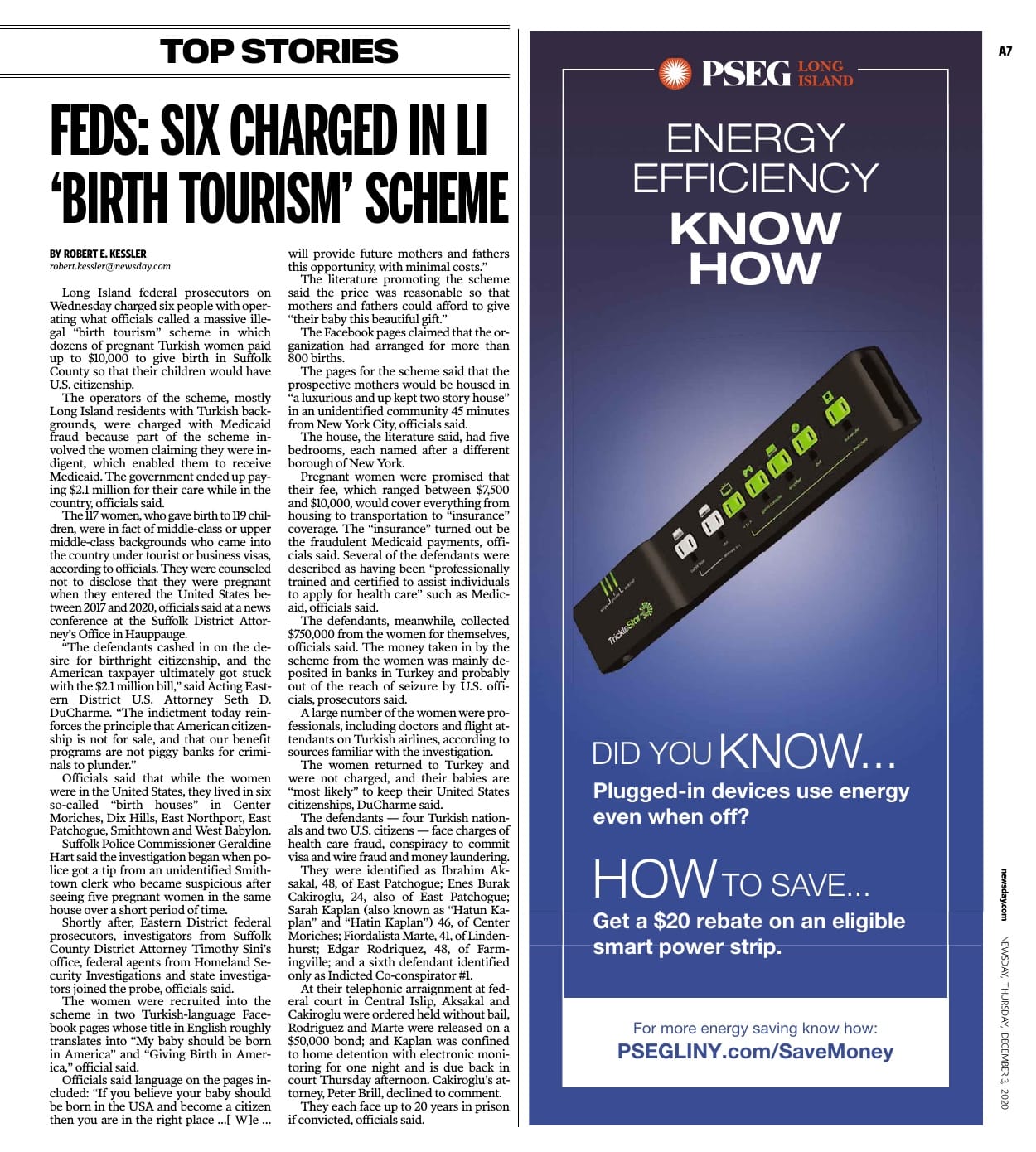
Six charged in Long Island birth-tourism scheme
The initial account reports the Smithtown lead, social-media recruitment, houses, fees, women and children, Medicaid allegations, defendants, and pretrial conditions.

The official federal indictment announcement
The release identifies the alleged seven-house operation, charged defendants, government-benefit allegations, financial activity, and presumption of innocence.
Aksakal’s guilty plea and agreed forfeiture
The preserved page records the guilty plea, admitted conspiracy, alleged scheme, and $397,500 forfeiture agreement.
Twenty-seven months for birth-tourism fraud
The sentencing account records imprisonment, time already served, restitution, forfeiture, the government’s position, and defense mitigation.
What supports each part of the account.
- Charging-stage reporting. Newsday, “Feds: Six charged in LI ‘birth tourism’ scheme,” December 2020. The preserved page reports the alleged recruitment, housing, fees, participant count, Medicaid benefits, defendants, and pretrial conditions.
- Guilty-plea reporting. Newsday, “Guilty plea in ‘birth tourism,’” October 2021. The preserved page records Aksakal’s plea and forfeiture agreement.
- Sentencing reporting. Newsday, “27 months for ‘birth tourism,’” March 2022. The preserved page records the sentence, restitution, forfeiture, time served, and sentencing positions.
- Official federal account. U.S. Attorney’s Office, Eastern District of New York, indictment release concerning seven alleged birth houses and six defendants. The release states allegations at the charging stage.
- Firsthand role account. Christopher Rizzi supplied the role information used here: wiretap coordinator. The draft does not substitute that account for the official charging or disposition records.
Complex fraud evidence becomes manageable when it is separated by person, source, and time.
Royal Palm Investigations supports counsel with communications analysis, social-media research, identity resolution, financial chronologies, and organized litigation-support investigations.