
The Long Island Case Behind the 2011 FBI Mafia Takedown

The Long Island Case Behind the 2011 FBI Mafia Takedown.
A local wiretap investigation developed evidence involving cocaine, illegal sports betting, witness intimidation, gambling locations, and organized-crime relationships before becoming part of the largest nationally coordinated Mafia takedown in FBI history. Christopher Rizzi served as the lead investigator in the local investigation and as the wiretap coordinator for the Spatafora wire.
The Spatafora plea and sentence are drawn from the official federal court opinion. National figures come from FBI and Justice Department records. Arrest-stage media allegations are identified as allegations, and the unresolved homicide issue is not presented as a finding.
A Long Island wiretap. A national arrest plan.
Before daylight on January 20, 2011, teams were already staged across New York and the Northeast. At Fort Hamilton in Brooklyn, a mobile command post coordinated the New York operation while tactical teams waited for the signal to move. By 6 a.m., arrests were underway. By 11 a.m., more than 110 of the 127 charged defendants were in custody.23
The public saw the scale: defendants tied to all five New York Mafia families, the New Jersey-based DeCavalcante family, and the New England Mafia; sixteen indictments in four federal districts; charges ranging from murder and narcotics trafficking to illegal gambling, extortion, labor racketeering, and obstruction. The FBI called it the largest nationally coordinated organized-crime takedown in Bureau history.4
The separate Alesi indictment supplied the defendant list for the Long Island gambling, extortion, and obstruction component. That group is identified below and kept distinct from Spatafora’s individual federal case.6
What the public could not see as easily were the smaller investigations underneath it. The FBI said the arrest blueprint had been drawn for months, while the contributing cases had been developing for years. Suffolk County detectives assigned to the district attorney’s office were among the participating partners.3
The Long Island component carried its own targets, intercepted calls, surveillance, cocaine activity, sports betting, witness risk, and local enforcement problems. Its evidence had to remain accurate for each person and offense even after the case was fitted into a national clock.
Fred Alesi, Anthony Arcuri, Robert Berliner, Lawrence Betro, Franklin Camarano, John Cavallo, Anthony Cavezza, Francis Costello, Dominick Delio, Robert Dito, Thomas Ditta, Frank Politi, Anthony Sabbagh, Ayub Sayed, Giovanni Vella, and Carlos Zambrano.6
The federal court identified him as an associate of the Colombo and Lucchese families who pleaded guilty to cocaine conspiracy, witness intimidation, and operating an illegal sports-betting business.
Rizzi served as the lead investigator in the local investigation and as the wiretap coordinator for the Spatafora wire, organizing intercepted communications and helping integrate the local evidence into coordinated enforcement planning.
Contemporaneous reporting described nine alleged gambling locations and at least 16 people accused in the Long Island operation.
At the arrest stage, contemporaneous reporting said Dito and Camarano pleaded not guilty to separate allegations involving warnings about gambling raids and assistance with business extortion.
Federal, state, county, city, and international partners coordinated arrests, searches, tactical support, evidence handling, and defendant processing.
From intercepted calls to a pre-dawn national sweep.
The records reveal the case in layers. The federal sentencing opinion supplies admitted conduct and punishment. FBI and Justice Department accounts show how the national operation was assembled. Contemporary Long Island reporting captures the local gambling, extortion, and former-officer allegations at the moment of arrest. Read together—and kept within their proper limits—they show how a wiretap case moved from individual calls and surveillance events into coordinated enforcement.
Hours before the arrests, close to 800 FBI agents and professional staff and roughly 130 partner officers were positioned for the New York operation. Team leaders delivered final instructions. Two mobile command posts, SWAT units, evidence-response personnel, imaging specialists, and tactical teams stood ready. By 6 a.m., the arrests were in full swing.3
Hundreds of officers moved on one coordinated signal.
The national operation reached four federal districts: Brooklyn, Manhattan, Newark, and Providence. The Justice Department announced 16 indictments covering 127 defendants—91 alleged members or associates of seven La Cosa Nostra families and 36 others charged in associated criminal activity. More than 30 alleged “made” members were among those charged.4
At Fort Hamilton, teams in the command post and on the street waited for the all-clear from the FBI’s New York criminal division. The support structure included two mobile command posts, SWAT units, Evidence Response Teams, imaging specialists, and tactical operations personnel. The Army base also became the processing center, where fingerprints and arrest information were handled as defendants arrived.3
This was not one case with 127 defendants. It was a synchronized enforcement day built from separate investigations, separate indictments, and conduct that reached across decades. The Long Island work entered that morning with its own evidence and its own history.
Cocaine, gambling, and a business that connected the two.
The federal court identified Robert Spatafora as an associate of the Colombo and Lucchese crime families. He had operated a towing company from 1993 to 2006 and an auto-repair business from 2001 until his 2010 arrest. That repair business became a physical center of the conduct later described at sentencing.1
From July 2009 through February 2010, the court found, Spatafora used the business to receive cocaine deliveries and broker purchases by telephone for friends, employees, and acquaintances. Some purchases were worth as little as $100; on another occasion, he loaned a coconspirator $5,000 to buy cocaine. The same business supported an illegal sports book that accepted wagers by telephone and through a website registered in Costa Rica.1
For investigators, the location mattered because it gave calls a physical setting. A discussion about price or quantity could be compared with a delivery, a meeting, a vehicle, or activity at the shop. Gambling conversations could be separated from drug transactions, even when the same people or location appeared in both.
Rizzi worked as the lead investigator in the local investigation and as the wiretap coordinator for the Spatafora wire. His responsibility was not simply to accumulate calls. The intercept had to be organized around speakers, targets, pertinent conversations, corroborating surveillance, known events, and the evidence required for each alleged offense.
Voice, identity, context, and sequence.
A wiretap can create volume faster than it creates understanding. Calls arrive in fragments. People use nicknames, indirect language, borrowed phones, and shared knowledge that is never explained aloud. One call may sound unimportant until surveillance documents a meeting minutes later. Another may become relevant only after a speaker is reliably identified or a later event explains what the participants meant.
As the wiretap coordinator for the Spatafora wire, Rizzi helped organize that flow: minimization, dissemination, speaker attribution, pertinent-call review, and the connection between intercepted words, surveillance, meetings, transactions, vehicles, and known locations. Each useful communication needed a place in the chronology and a defensible reason for being linked to a person or event.
The lead investigator role required a second level of control. The broader case could contain narcotics, gambling, witness conduct, and organized-crime relationships, but the proof still had to remain person-specific. A family association could supply investigative context; it could not replace evidence that a particular subject joined a particular act.
An illegal gambling operation hidden inside ordinary routines.
The court found that the gambling business operated from July 2009 through May 2010, involved five or more people, continued for more than 30 days, and earned at least $2,000 on a single day. Bets were placed by telephone and on a Costa Rica-registered website that described itself as being for entertainment while allowing registered users to wager money on sports.1
The online screen did not eliminate the street-level work. Accounts had to be managed, losses settled, and debts collected. The court found that Spatafora used acquaintances to collect from bettors. Those acts gave investigators events outside the phone traffic that could be compared with the communications.
The wider Long Island enforcement picture was larger still. Contemporaneous reporting described at least 16 people accused of extorting businesses and operating underground gambling clubs. Nine alleged card-game locations were identified: one in Hauppauge, one in South Farmingdale, an auto-body shop in Westbury, two locations in Ronkonkoma, and four in Bohemia.5
That local reporting also described claims that businesses were pressed for kickbacks under threats of violence. Those were arrest-stage allegations, not findings. They nevertheless show why the case could not be understood from betting records alone: the inquiry extended to locations, collectors, business relationships, and the methods allegedly used to enforce payment.
The investigation became a question of safety and evidence integrity.
The sequence began on March 30, 2010, when a woman associated with Spatafora was arrested on an unrelated bench warrant. According to the sentencing opinion, Spatafora told his wife that he believed police had questioned the woman about the 2003 killing of Peter Ghattas, an employee who had been murdered in the parking lot of Spatafora’s auto-repair shop.1
On May 11, a series of government-recorded wiretap calls captured Spatafora accusing the woman of cooperating and threatening to kill her. Count Four charged that the threats were intended to hinder, delay, or prevent communication with FBI agents. He later pleaded guilty to that count.1
At sentencing, Spatafora characterized the threats as words spoken hastily and passionately. The judge rejected that view, concluding that the words had consequences for both the person threatened and the investigative and judicial processes they were meant to disrupt.
The opinion also recorded the government’s position that Spatafora remained a suspect in the Ghattas homicide and Spatafora’s emphatic denial. It made no homicide finding. The distinction matters: the witness-intimidation conviction is established; the homicide issue remained unresolved.
Three counts resolved while the national plan was still taking shape.
On October 1, 2010, Spatafora pleaded guilty to three counts of a five-count superseding indictment. Count Three covered cocaine conspiracy from July 2009 through February 2010. Count Four covered witness intimidation from March through May 2010. Count Five covered the gambling business from July 2009 through May 2010.1
The plea fixed those three forms of conduct in the public record before the nationally coordinated arrests. It also preserved an important distinction: the cocaine activity, witness threat, and gambling business were connected by people and evidence, but each count had its own time period and legal elements.
At roughly the same time, the Justice Department and FBI were preparing the national operation. The FBI later said formal planning began months before January 20, while the underlying investigations had been underway for years. The Long Island work entered that process as developed evidence—not as a case invented for the sweep.
Arrest teams, searches, evidence recovery, and operational security.
National coordination did not erase the local case. It made precision more important. Warrants, arrest teams, target locations, surveillance coverage, evidence priorities, and defendant processing all had to align with the broader operation while remaining accurate for each local subject.
The FBI’s New York account shows the operational layers: close to 800 Bureau personnel and roughly 130 partner officers, two command posts, tactical units, evidence teams, imaging specialists, and a centralized processing site at Fort Hamilton. The partner list extended from Suffolk detectives and federal prosecutors to the NYPD, state police agencies, federal inspectors, marshals, the DEA, the Waterfront Commission, and the Italian National Police.3
The Long Island component also carried insider-risk concerns. The Justice Department said one indictment charged former Suffolk County officer Robert Dito with obstructing a state gambling investigation by warning a business about upcoming raids. Long Island Press reported that he pleaded not guilty and separately faced a state official-misconduct charge alleging discounted auto repairs in exchange for tips. The same report said former Nassau officer Franklin Camarano pleaded not guilty to charges that he helped a Mafia crew extort local businesses.45
Those were allegations at the time of arrest, not findings. Operationally, however, the possibility that subjects knew police methods or had access to sensitive information affected how targets, sources, communications, and enforcement plans were protected.
The local court record supplied its own ending.
The court calculated an offense level of 20 and a criminal-history category of I, producing an advisory imprisonment range of 33 to 41 months. On May 27, 2011, the judge imposed the top of that range: 41 months in prison, followed by three years of supervised release.1
The financial judgment was also specific. The court imposed a $25,000 fine, a $300 special assessment, and forfeiture of $187,167. The opinion stated that proceeds from the government sale of an automobile held by the Suffolk County Police Department would satisfy the fine.1
The judge emphasized the witness tampering, deliberate illegal conduct, and need for deterrence. The sentence reflected three different forms of admitted conduct: cocaine conspiracy, witness intimidation, and illegal gambling. The national takedown supplied the scale and public image. The Spatafora opinion supplied the smaller, exact record of what one local defendant admitted and how the court treated it.
The ability to manage complexity without losing the individual case.
For Rizzi, the investigation joined two demanding roles. As the wiretap coordinator for the Spatafora wire, he had to turn a stream of intercepted conversations into a reviewable record: identify speakers, preserve minimization and dissemination, connect calls to surveillance and known events, and keep relevant communications available to the investigators who needed them.
As the lead investigator in the local investigation, he also had to help keep the whole case coherent. Drug activity, gambling, debt collection, witness conduct, organized-crime relationships, former-officer allegations, arrests, searches, and multi-agency coordination could not be allowed to blur into one broad accusation.
That experience now applies when attorneys face large discovery sets, intercepted calls, call-detail records, conspiracy allegations, surveillance, witness issues, or an enterprise theory that may be broader than the evidence tied to a particular client. The practical question remains the same: what does the record establish about this person, on this date, in this event?
What the case taught.
The lasting value is not the size of the takedown. It is the discipline required to keep a wiretap case accurate while the number of calls, subjects, agencies, charges, and operational risks grows.
Make every intercepted voice reviewable.
Speaker attribution, context, minimization, dissemination, and corroboration determine whether a call can carry evidentiary weight.
Separate connected offenses.
Cocaine, gambling, witness intimidation, and organized-crime affiliation may overlap without proving the same conduct or intent.
Protect the operation from insider risk.
Former-officer allegations require controlled access and careful planning, but employment history never substitutes for proof.
Preserve the local evidence inside the large theory.
National coordination cannot weaken the chronology, attribution, or evidence tied to an individual subject.
Read the records behind the story.
The source cards preserve the local sentencing record, official national-operation accounts, and contemporaneous Long Island reporting. Each source is used only for what it establishes.
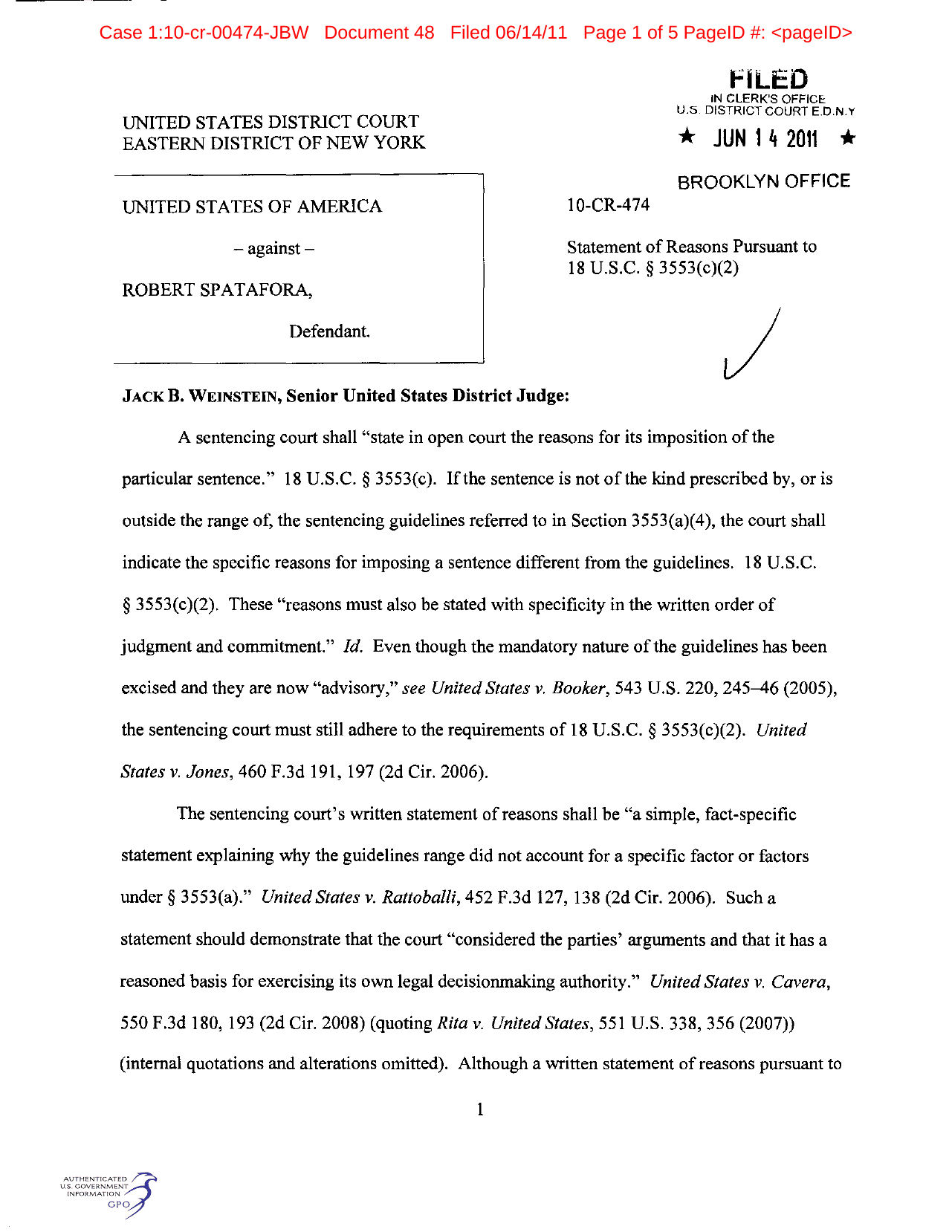
U.S. v. Robert Spatafora sentencing opinion
The official court record establishes the guilty plea, offense periods, wiretap-recorded witness threats, cocaine and gambling conduct, sentence, fine, and forfeiture.
The largest nationally coordinated organized-crime takedown
The FBI account documents the operation’s scale, participating crime families, charges, personnel, planning, arrests, and early-morning coordination.
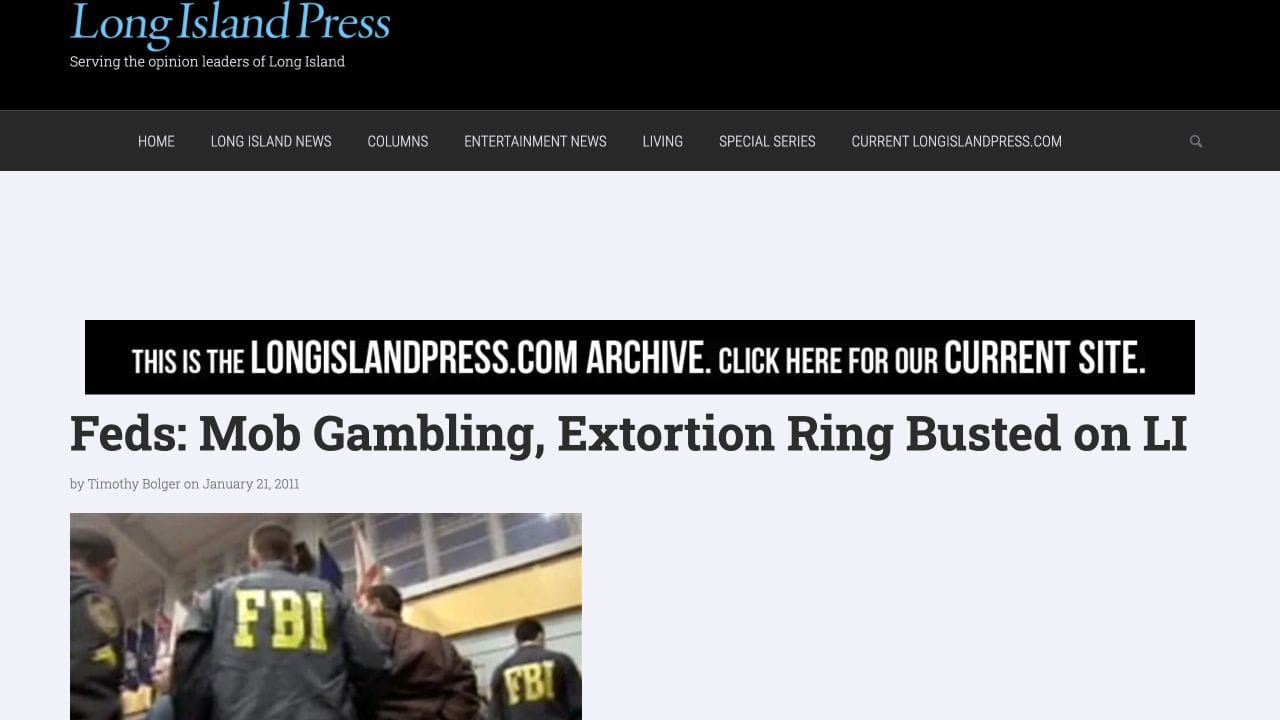
The Long Island gambling and extortion component
The contemporaneous local report describes the alleged gambling locations, business-extortion activity, local defendants, and former-officer allegations at the arrest stage.

Two former Long Island officers among the arrests
This report is preserved as a contemporaneous arrest-stage account. It is not used to imply a conviction or disposition beyond the record it describes.

Witness intimidation and a separate unresolved allegation
The article is retained as contemporaneous sentencing coverage. The homicide issue remains an allegation; the federal court opinion is the controlling source for the offenses of conviction.
What supports the account.
- U.S. v. Spatafora. Eastern District of New York, 10-CR-474, Statement of Reasons Pursuant to 18 U.S.C. § 3553(c)(2), filed June 14, 2011. The opinion establishes the plea, offense periods, conduct summarized by the court, and sentence.
- FBI national account. “Mafia Takedown: Largest Coordinated Arrest in FBI History,” January 20, 2011. It establishes the Bureau’s description of the operation and the 127-defendant scale.
- FBI New York operation account. “Organized Crime Lives On; FBI Rounds Up Mafia Associates in Largest Coordinated Takedown,” January 20, 2011. It identifies participating Suffolk detectives and describes command posts, personnel, planning, arrests, and processing.
- Justice Department announcement. “91 Leaders, Members and Associates of La Cosa Nostra Families in Four Districts Charged,” January 20, 2011. It documents the 16 indictments, 127 charged defendants, alleged offenses, partner agencies, and former-Suffolk-officer obstruction charge.
- Long Island Press. Timothy Bolger, “Feds: Mob Gambling, Extortion Ring Busted on LI,” January 21, 2011. The report is used for contemporaneous local allegations and is not treated as a later court disposition.
- Long Island defendant list. United States v. Alesi, et al., Eastern District of New York indictment, filed January 11, 2011. The caption identifies the 16 defendants listed on this page; the indictment states allegations at the charging stage.
- Firsthand role account. Christopher Rizzi supplied the role information used here: lead investigator in the local investigation and wiretap coordinator for the Spatafora wire.
Large cases still turn on individual evidence.
Royal Palm Investigations supports counsel with wiretap and communications review, surveillance analysis, timelines, witness issues, and person-specific evidence mapping in complex criminal and civil matters.