Inside Illegal Dumping Scheme “Operation Pay Dirt”

Operation Pay Dirt: Inside an Alleged Illegal-Dumping Network.
A complaint about “clean fill” developed into an undercover investigation of alleged dirt brokers, waste facilities, trucking companies, false laboratory reports, public and private dumping sites, bank activity, and coordinated enforcement. Christopher Rizzi served as lead investigator and wiretap coordinator.
This account preserves the difference between allegations, arrests, charges, seizures, defense responses, and any later disposition. The two contemporaneous Newsday pages describe the developing enforcement action at different points. Rizzi’s role is based on his firsthand account of the investigation.
A promise of free clean fill opened a window into an alleged disposal economy.
Newsday reported that the investigation began in February after county investigators learned that a dirt broker offered a Central Islip homeowner free clean fill but allegedly arranged for solid waste, construction debris, and demolition debris to be placed in the backyard instead.1
The alleged scheme turned an ordinary landscaping transaction into a chain of investigative questions: who generated the material, who brokered it, which company hauled it, what the load contained, what laboratory report accompanied it, where the truck traveled, who was paid, and what finally entered the ground.
Operation Pay Dirt expanded through undercover work, intercepted communications, surveillance, truck movements, company and financial records, environmental sampling, and multi-agency coordination. Public accounts described newly identified sites across Long Island and New York City, including private yards, parks, public land, and a property next to a middle school.12
Newsday identified Grazio as a central dirt broker accused of arranging fill deliveries and brokering relationships among facilities and trucking companies.
The investigation examined whether businesses worked together to move construction and demolition debris into unlawful disposal sites.
Authorities alleged that homeowners were approached through online advertisements and door-to-door solicitation and were shown false or misleading laboratory reports.
Each location required its own load history, truck evidence, sampling, custodian, and remediation analysis.
Rizzi served as lead investigator and wiretap coordinator, helping connect communications with people, companies, trucks, payments, and locations.
The case required investigative, environmental, financial, and enforcement personnel to work from a common but source-specific record.
Dirt became evidence only when every load was tied to a company, truck, payment, and site.
The public account describes an alleged business model built on avoided disposal costs. Investigators had to test that theory against actual loads, communications, records, ground conditions, and individual knowledge.
Legal disposal could cost approximately $1,500 per truckload on Long Island. Newsday reported that investigators alleged some trucking companies were paid about $700 per load to haul material away illegally. The gap created the alleged profit – and the motive to disguise debris as clean fill.
Nearly two dozen arrests exposed only the visible edge of the investigation.
First-day Newsday coverage reported 23 arrests, charges involving 12 companies, and 18 seized vehicles. The following day’s expanded account described 24 arrested people, charges against 12 companies, 27 trucks seized, and approximately $4.4 million frozen in bank accounts.12
The later account reported 20 search warrants. Officials described the action as the state’s largest illegal-dumping case in years and said the investigation would continue through a special grand jury examining remediation and the broader practice of dumping in Suffolk County.
Those numbers reflected an enforcement phase, not a final adjudication. The charged people and companies remained entitled to contest the allegations, and public defense statements did exactly that.
Free clean fill allegedly arrived as something else.
Investigators learned of a broker who allegedly offered a Central Islip homeowner clean fill at no charge but arranged for solid waste and construction or demolition debris to be deposited instead. The reported broker, Anthony Grazio, also known as “Rock,” worked in recycling and solid-waste management, according to officials.1
The homeowner’s account supplied a transaction that could be reconstructed: solicitation, representation, broker, company, truck, source facility, delivery, material, and payment. Investigators could then test whether the same structure appeared elsewhere.
Online advertisements and door-to-door offers turned private property into proposed disposal sites.
Newsday reported that Grazio allegedly sold or arranged clean fill through online advertisements and door-to-door solicitation. Officials accused participants of showing residents laboratory reports that said the fill was “up to code,” while alleging that the loads contained solid waste or debris.1
A laboratory report can appear authoritative while answering the wrong question. Investigators had to identify the sample, date, laboratory, chain of custody, material tested, person presenting the report, and whether the delivered load was the material actually analyzed.
The alleged misrepresentation therefore required both documentary and physical proof. Advertising described the promise. Sampling and site evidence addressed what arrived. Communications and company records addressed who knew what.
Investigators tracked brokers, trucks, facilities, and destination sites.
Officials described an undercover investigation in which state personnel followed people and companies involved in illegal dumping and tracked where waste was being taken. Operation Pay Dirt was also part of the larger statewide Operation TrashNet effort targeting increased illicit disposal of construction and demolition debris.2
Rizzi’s lead-investigator and wiretap-coordinator role required intercepted communications to be compared with physical movements. A call about a load or site had to be placed beside the correct truck, company, driver, timestamp, route, and destination. Wiretap and Title III review later depends on the same discipline: interpretation must remain connected to corroborating events.
Investigators also had to avoid collapsing corporate identity. A broker, generator, facility, truck owner, driver, recipient, and property owner might all appear in the same transaction while having different knowledge and legal exposure.
Avoided disposal costs allegedly financed the network.
A state environmental official told Newsday that legal disposal cost approximately $1,500 per truckload on Long Island and could be double or triple depending on the contents. Investigators alleged that some facilities paid trucking companies roughly $700 per load to take material away illegally.1
The charged companies were alleged to have saved hundreds of thousands of dollars. That theory had to be tested through invoices, accounts, facility records, truck logs, payments, contracts, and the actual materials recovered. Financial and asset investigation is relevant only when the account and payment can be linked to the correct company, load, and event.
Officials later froze approximately $4.4 million in accounts and announced plans to seek seizure or forfeiture of assets allegedly used in the scheme. A freeze or seizure is a procedural event; it is not itself a final finding that every dollar represented unlawful proceeds.
The investigation expanded to 25 reported locations.
Newsday reported that Operation Pay Dirt uncovered 21 new alleged dumping sites, bringing the reported total to 25 locations investigated. The sites included public land and parks. Officials highlighted property between Brentwood State Park and Brentwood North Middle School where construction and demolition debris had been found.2
Another account described the school-adjacent property as land a nonprofit youth soccer club planned to refurbish and use. Public officials said remediation could not begin until responsibility for the dumping was determined. That placed investigative attribution directly beside public-health and restoration decisions.
Environmental evidence had to remain site-specific. Soil or debris from one backyard could not establish what another company deposited near a park, school, or body of water. The record required load, location, source, sampling, and custody for each site.
The charging record alleged different conduct by individuals and companies.
Newsday reported that Grazio faced 50 felony counts, including criminal mischief, and 74 misdemeanor counts. Court records cited by the newspaper set bail at $167,000 bond or $77,000 cash. Other defendants and companies faced charges tied to alleged hauling, disposal, sites, or business activity.1
Defense attorneys quoted by Newsday denied allegations for their clients. One said third parties delivered fill said to be compliant; another denied that his client was a dirt broker. Those responses belong in the public record because they show that the charging theory was disputed.
A case involving many businesses can easily become overgeneralized. The investigative record must identify which communication, invoice, truck, load, sample, payment, and site was attributed to each defendant or company.
The Long Island case sat inside a larger enforcement effort.
Officials said Operation Pay Dirt formed part of Operation TrashNet, a statewide initiative launched in 2017 to address increased illegal disposal of construction and demolition debris. Newsday reported that state investigators had tracked people and companies, issued hundreds of environmental tickets involving trucking companies, and identified illegal dumping sites across the state.2
The statewide context explained why the investigation involved environmental agencies, county police, prosecutors, and multiple enforcement teams. It did not eliminate the need to prove the Long Island allegations from local evidence.
What an environmental conspiracy demands from investigators.
The case required undercover development, communications analysis, surveillance, company and payment records, truck tracking, environmental sampling, site-by-site evidence control, and multi-agency enforcement.
The enduring method is disciplined attribution. Every load must remain connected to the company, truck, person, payment, destination, and physical evidence that support the conclusion.
Keep every site connected to its proof.
Sampling, photographs, truck evidence, property records, and witnesses should remain location-specific.
Test documents against physical reality.
A laboratory report or invoice is useful only when it describes the material and transaction actually under review.
Separate companies and roles.
Generators, brokers, facilities, haulers, drivers, and property owners occupy different positions in the evidence.
Distinguish enforcement from disposition.
Arrest, seizure, frozen assets, charges, defenses, pleas, and convictions are different procedural facts.
Read the reporting behind the story.
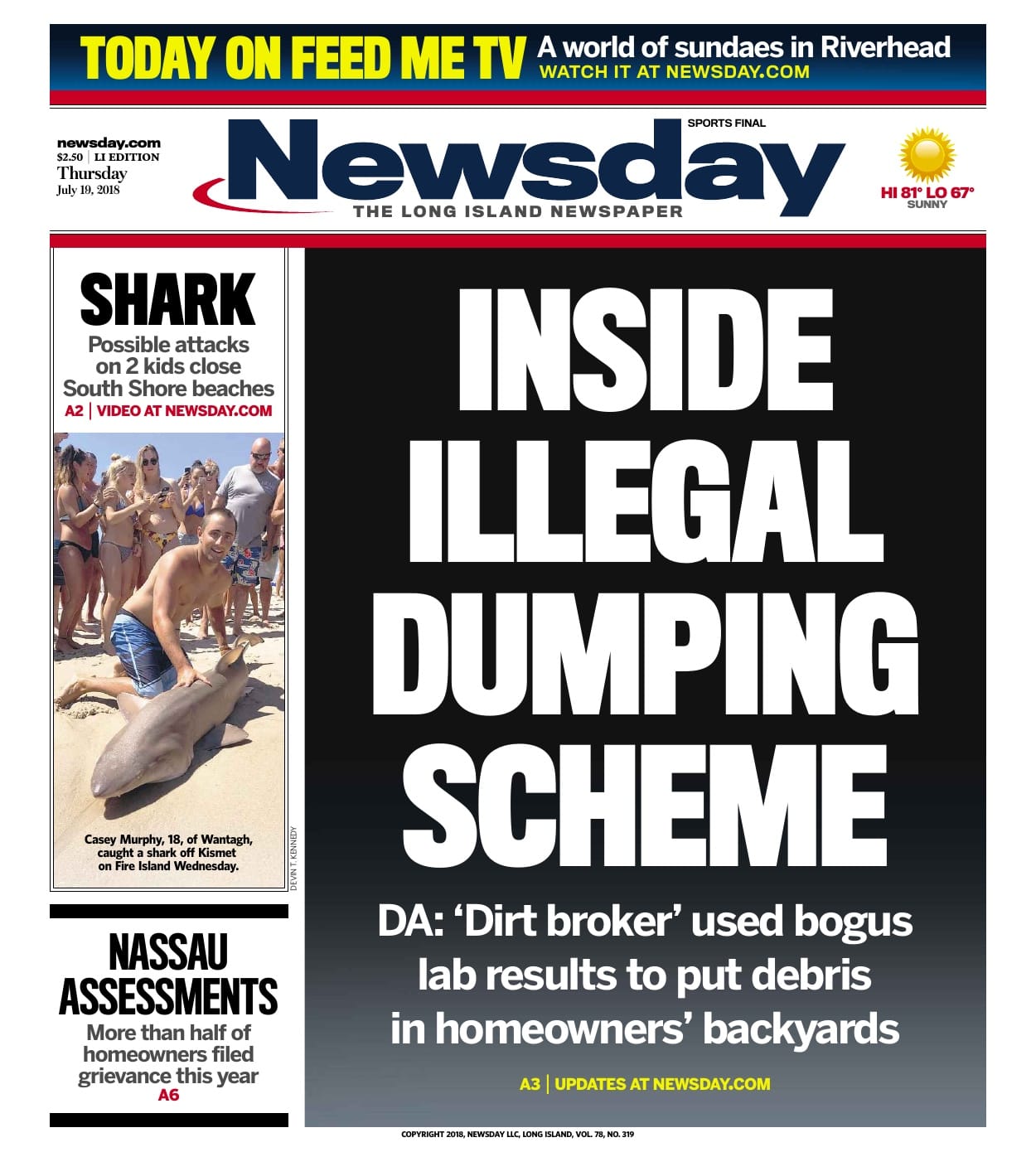
The two preserved Newsday pages document the initial undercover action and the expanded account of the alleged network, sites, economics, charges, seizures, and statewide context.

Dumping bust a record
The initial account reports the undercover investigation, alleged clean-fill representation, arrests, companies, vehicles, new sites, and Operation TrashNet context.
Hitting “Pay Dirt”
The expanded account reports the alleged broker network, false lab reports, disposal economics, trucks, frozen accounts, search warrants, charges, defense responses, and school-adjacent site.
What supports each part of the account.
- Expanded enforcement account. Newsday, “Hitting ‘Pay Dirt,’” July 19, 2018. The preserved page reports the alleged broker, solicitation, laboratory reports, disposal economics, sites, warrants, charges, companies, trucks, frozen accounts, and defense responses.
- Initial enforcement account. Newsday, “Dumping bust a record,” July 18, 2018. The preserved page reports the undercover action, arrests, companies, vehicles, 21 new sites, 25 total locations, public land, and Operation TrashNet context.
- Firsthand role account. Christopher Rizzi supplied the role information used here: lead investigator and wiretap coordinator. That account does not substitute for charging or disposition records.
Complex operations leave a trail when every load, payment, truck, and site is organized correctly.
Royal Palm Investigations supports counsel with surveillance analysis, wiretap review, financial tracing, chronologies, and evidence organization in complex criminal and civil matters.