
Inside a Suffolk Wiretap

Inside a Suffolk Wiretap
A 2006 narcotics lead became a court-authorized wiretap investigation involving financial records, suspected narcotics activity, searches, seizures, surveillance, and nearly a dozen phones. Its later disposition and sealed records raised questions about what investigators developed, what prosecutors charged, and how institutional power affected the case.
This account combines investigators’ firsthand accounts of their work on the original matter with contemporaneous reporting, released affidavits and court records, and public federal records. Firsthand accounts describe what investigators personally did, observed, learned, or were told during the investigation. Interpretations, assessments of motive, and information not independently established by public records are identified as investigators’ views or reported allegations. Superscript numbers link to the notes and sources.
The connection was institutional, not legal.
Suffolk County occupies the eastern portion of Long Island, New York. Its criminal-justice system brings elected prosecutors, county detectives, police commanders, defense attorneys, judges, and political organizations into frequent contact. Detectives develop facts and recommend action. Prosecutors decide which charges to file, what plea to accept, and how a case will be presented in court.
The Macedonio matter began with a narcotics lead and developed into a 2007 Title III wiretap and financial investigation. It examined Robert Macedonio and a range of suspected narcotics, financial, and public-corruption conduct. The public prosecution ended in a felony drug plea that was later replaced with a misdemeanor.
The later Burke federal case concerned former Suffolk County Police Chief James Burke’s assault of Christopher Loeb and the effort to obstruct the federal civil-rights investigation. Several senior officials who held authority over the earlier investigation were later prosecuted in the separate federal case.915
The principal figures and groups.
A veteran defense attorney, former Suffolk prosecutor, and player in county Republican politics. He was the subject of the original wiretap and financial investigation.34
The elected Suffolk County district attorney. His office controlled the Macedonio prosecution and disposition. A federal jury later convicted him in the separate Burke obstruction case.315
Chief of the Government Corruption Bureau and part of the command structure above the detectives. He was later convicted with Spota in the Burke case.815
A senior police official who later became police chief. He was federally indicted in 2015 and pleaded guilty in 2016 to violating Loeb’s civil rights and conspiring to obstruct justice.1920
Rizzi served as the lead investigator in the Macedonio investigation.1
A core group of four Government Corruption Bureau personnel, later joined by county officials.1
A term members of the leadership circle used for themselves, according to later federal-court testimony.1316
From a narcotics lead to a public reckoning.
The public ending belonged to a different case.
In August 2021, U.S. District Judge Joan M. Azrack sentenced former District Attorney Thomas Spota and former Government Corruption Bureau chief Christopher McPartland to five years in prison. A federal jury had convicted them of obstructing the investigation of Burke’s assault of Loeb, tampering with witnesses, and acting as accessories after the fact to the civil-rights violation. Spota also received a $100,000 fine.1718
That judgment closed the separate Burke prosecution. The earlier Macedonio matter supplies context for what Rizzi and his investigative partners had already experienced inside the Suffolk County system.
Nonpublic information had reached a defense attorney.
Rizzi was working in a Suffolk County narcotics squad when an undercover drug purchase led to an arrest. During a later proffer, a meeting in which a defendant gives information to investigators and prosecutors, the defendant said Macedonio already knew details about the arrest and seizures that had not been made public. The investigators’ firsthand account identifies that disclosure as the starting point of the inquiry.1
Protecting undercover identities was an immediate concern. Investigators received information alleging that Macedonio helped drug dealers avoid arrest, identified undercover detectives, facilitated large cocaine transactions, and helped gang members evade law enforcement. Those claims were leads requiring corroboration, not established findings.12
Macedonio had been a Suffolk County prosecutor before becoming a veteran criminal-defense attorney. He was also a player in county Republican politics. Newsday later described a courthouse figure with relationships extending across the defense bar, public offices, law enforcement, and local politics.34
In early 2007, Rizzi and his partner transferred to the Government Corruption Bureau to continue the case. Rizzi served as the lead investigator. A judge authorized telephone interception under Title III, and the surveillance expanded to nearly a dozen phones.1
Title III controlled how investigators intercepted, reviewed, minimized, documented, and used private communications. Monitors identified speakers and coded language while surveillance teams, witnesses, financial records, and searches supplied independent context. Supervisors and prosecutors reviewed the developing leads to decide what additional legal process or fieldwork was justified.
Released records described mortgage, bank, escrow, property, narcotics, and witness-related allegations. Judges authorized a search of Macedonio’s law office and the seizure of accounts and property. Court filings later placed alleged proceeds associated with financial schemes above $4 million.23
Doors Behind Doors
Newsday later reported allegations that intercepted conversations involved cocaine purchases, warnings about informants, campaign-contribution laundering, patronage positions, judgeships, gang members, drug traffickers, and public officials. Each was an investigative lead requiring separate proof and a separate charging decision.4
According to the investigators’ firsthand account, the team disrupted two planned robberies. One was a proposed home invasion targeting a drug dealer. Newsday reported that investigators built dossiers involving cocaine dealers, armed robbers, and public officials, and that the case appeared to be moving toward possible charges involving drug trafficking, mortgage fraud, public corruption, and cocaine distribution in Long Island high schools. Much of that alleged conduct did not result in public charges.14
According to a released search-warrant affidavit, Macedonio allegedly allowed people with criminal records to work as mortgage brokers under his license, received portions of their commissions, made a false filing to banking authorities, and participated in fraudulent mortgage activity through a business at his law office. The affidavit also described narcotics allegations. Some information came from an informant, and the later records did not establish that every claim was verified or adjudicated.2
The expanding scope did not mean every lead belonged in one prosecution. Each possible offense required its own evidence, legal theory, subjects, and charging review. Investigators had to preserve matters that were still developing while acting immediately on threats such as the planned robberies. That combination of urgent fieldwork and long-term documentation made the case operationally demanding.
A broad investigation ended in one felony drug plea.
In December 2008, Macedonio pleaded guilty to felony cocaine possession. The conviction cost him his law license. Records later unsealed at Newsday’s request described allegations the prosecution agreed not to charge, including mortgage fraud, cocaine sales, grand larceny, witness tampering, and related conduct.23
Names and details remained redacted to protect uncharged people, undercover officers, informants, and other sensitive information. The plea resolved the prosecution without trials on the wider body of alleged conduct investigators had examined.
The investigators’ assessment was that other developed matters also supported charges. They identified the disrupted robberies, drug activity involving a high school, and possible crimes involving public officials. McPartland declined to prosecute multiple people whom the investigators believed the evidence supplied probable cause to charge.1
Those decisions shaped the investigators’ later conclusion about how the wiretap had been used. They believed it had served not only to establish evidence of suspected crimes, but also to gather intelligence involving political operatives aligned against Spota. This was their assessment based on the work and the decisions they observed, not a finding in the public court record.1
A negotiated plea may reflect proof problems, witness concerns, legal limits, or a prosecutor’s judgment about the public interest. The existence of uncharged allegations does not establish that every available charge should have been filed. Here, the investigators’ concern arose from the combination of evidence they believed had been corroborated, limits placed on follow-up, and the breadth of conduct omitted from the final disposition.
The felony was replaced with a misdemeanor.
With support from the district attorney’s office, Macedonio’s felony conviction was vacated, meaning set aside as a legal judgment, and replaced with a misdemeanor. Removing the felony cleared the principal obstacle to restoring his law license. Newsday later reported that its review of more than 400,000 Long Island felony cases found no other matter following the same pattern. The district attorney’s office, Macedonio, and his attorney denied that anything improper had occurred.3
Investigators later learned of an alleged arrangement connected to Macedonio regaining his law license. According to the information they received, part of the arrangement was that he would stop communicating with a political adversary of Burke and abandon a book he was preparing about Burke. The available court record did not establish those conditions as terms of the disposition.1
Newsday reported that attorneys familiar with criminal practice regarded the sequence as highly unusual. Much of the relevant proceeding remained sealed or absent from the ordinary public file, and the available record did not disclose a publicly tested finding that explained the change. The unusual sequence, the incomplete file, and the competing accounts became central to the newspaper’s later examination.3
Reporters reconstructed a case from incomplete and sealed records.
Newsday’s February 2016 investigation traced the narcotics and financial inquiry, the law-office search, seized assets, the felony plea, the misdemeanor substitution, and the restoration of Macedonio’s license. Reporters used court papers, interviews, database analysis, and records requests to examine gaps in the public file.3
The underlying materials were not released through routine requests. Suffolk County produced none of the wiretap records Newsday sought under the Freedom of Information Law. The newspaper went to court and formally moved to unseal the search-warrant affidavit and plea agreement. The district attorney’s office opposed their release, but Judge James Hudson ruled in Newsday’s favor and unsealed the records in May 2016.25
No single open file supplied the complete chronology. The reporting reconstructed the matter from fragments and treated missing or sealed records as questions requiring examination. It asked what the original investigation encompassed, who approved the disposition, and what became of alleged conduct that never appeared as a public charge.
The reporting and federal investigation developed in parallel, using different powers. Newsday could pursue records, interviews, and public accountability. Federal investigators could issue subpoenas, compel testimony, and evaluate evidence for criminal prosecution. In March 2016, Newsday reported that federal prosecutors subpoenaed Macedonio materials, including wiretap audio and transcripts, and people connected to the original matter.5
Investigators carried their institutional knowledge outside the county chain.
Four Government Corruption Bureau personnel formed a core group they called “the Resistance.” They compared patterns across cases and developed what they considered a roadmap connecting people, relationships, evidence, charging outcomes, unexplained decisions, and the hierarchy through which those decisions moved. County officials later joined the group.1
Its members worked inside the district attorney’s Government Corruption Bureau, where their work moved through McPartland and Burke to Spota. They saw both the evidence developed in sensitive investigations and the decisions made after it moved upward. They came to believe that relationships and political value influenced which matters advanced, which were narrowed, and which received little follow-up. That was their assessment of patterns across cases, not a conclusion established by one intercepted call or court ruling.1
Burke’s federal indictment and arrest in December 2015 showed the Resistance that Eastern District prosecutors were willing to pursue corruption involving Suffolk’s law-enforcement leadership. Members made contact covertly with prosecutors working the Burke case and met them outside government offices to share their firsthand experience and explain the roadmap. Burke pleaded guilty in February 2016. In March, Newsday reported that federal prosecutors subpoenaed Macedonio wiretap materials and people connected to the original matter.151920
Newsday reported in May that detectives assigned to the Government Corruption Bureau had requested transfers. Sources told the newspaper that investigators feared McPartland’s continued role could compromise ongoing cases while he was reportedly a federal grand-jury target.8
The investigators’ assessment was that cases developed under McPartland could later be challenged if his conduct became an issue. Rizzi and his partner returned to narcotics rather than continue investing in work they believed might be compromised. Rizzi later became a Homeland Security task-force officer in the same federal building as the prosecutors handling the developing case.1
Taking information outside the county command structure carried professional risk. The people implicated by the roadmap controlled assignments, access, reputations, and careers within the same system where the investigators worked. The transfers made that break visible while members of the Resistance were assisting outside authorities.
Reporting brought disputed relationships and decisions into the open.
Newsday’s April 2016 reporting examined payments by defense attorneys to a corporation controlled by a veteran prosecutor for gatherings and fishing charters on his 47-foot boat. Some attorneys described renting the boat as a way to curry favor. The district attorney’s office said the payments covered ordinary operating, food, and beverage costs. Ethics specialists identified a potential conflict.6
Officials told Newsday that investigators had received information alleging Macedonio made a $2,500 payment disguised as a boat charter to thank the prosecutor for supporting an offender’s early release. They said investigators corroborated aspects of the account by examining the release and the claimed cooperation. The reported payment remained an allegation and did not result in a charge.46
The suspected arrangement was among the matters investigators intended to monitor during the wiretap. Early calls referred to the boat, then the contact stopped. Newsday reported that telephone records showed frequent earlier contact and that Macedonio later complained the prosecutor was no longer returning his calls. Officials quoted by the newspaper said the team was not permitted to interview key people and suspected someone inside the district attorney’s office had warned the prosecutor. Spota rejected the account. The investigators’ firsthand account states that the available lead was not meaningfully pursued.14
A separate Forkin wiretap investigation raised another concern. During the post-arrest phase, Rizzi received information indicating that investigative details may have reached people outside the authorized team, including targets of the investigation. The information also identified a family connection linking a target’s associate to a police lieutenant who had been a close friend and former partner of Burke. That relationship did not establish who disclosed the information. It gave investigators a reason to examine whether the case had been compromised. The assigned prosecutor was advised, but the district attorney’s office showed no interest in pursuing the possible leak.1
In May 2016, County Executive Steve Bellone publicly demanded Spota’s resignation. He accused the district attorney of protecting political friends and punishing enemies, and cited possible crimes heard during the Macedonio wiretaps but not prosecuted. Spota refused to resign, called Newsday’s reporting flawed, and accused Bellone of a personal vendetta tied to cases involving Bellone’s associates. Bellone denied seeking favors. Their competing accusations did not resolve the underlying claims, but they placed disputes about selective enforcement and political influence before the public.7
Bellone delivered a resignation letter at the district attorney’s Hauppauge office and also criticized Spota’s support for Burke. About an hour later, Spota held his own news conference. He said his office had supplied federal prosecutors with records and recordings, then alleged that Bellone had asked him not to pursue people close to the county executive. Bellone denied the allegation and said the dispute concerned corruption and public trust. The exchange widened as county lawmakers divided over responsibility and whether either official should leave office.7
Spota and McPartland were charged in the Burke cover-up.
In October 2017, a federal grand jury indicted Spota and McPartland. The indictment alleged that they joined an effort to protect Burke by identifying possible cooperators, pressuring witnesses, promoting false accounts, and obstructing the federal investigation. Both men pleaded not guilty. Spota announced the next day that he would leave office.910
Pretrial filings described meetings, telephone and cell-site records, witness pressure, efforts to identify a federal source, and alleged money for legal expenses. These were the government’s allegations before trial, and the defendants continued to deny them.1112
The case concerned the Burke assault and obstruction, not the Macedonio wiretap. Its institutional significance was that senior officials who had held authority over the earlier matter were now being examined by an outside prosecution.
Later testimony gave a public name to the leadership environment.
Former police lieutenant James Hickey testified about warnings concerning anyone who went against what members of the leadership circle called “The Administration.” The term described the network and influence surrounding senior officials. Hickey testified about threats to careers and efforts to find the person cooperating with federal authorities. Other testimony described surveillance of perceived enemies and the use of official power for personal or political purposes.1316
That testimony concerned participants in the Burke cover-up. It did not establish a threat made specifically to Rizzi or his partner. It did corroborate important features of the environment members of the Resistance had described to federal authorities, including retaliation, career pressure, and the use of institutional power against perceived enemies.1
Prosecutors used Hickey’s testimony with telephone evidence, records, other witnesses, and the history of the relationships among the men. Defense attorneys attacked Hickey’s credibility and argued that neither Spota nor McPartland knowingly joined a conspiracy.14
Hickey described a June 2015 meeting after the participants learned that federal authorities had reopened the Loeb investigation. According to the trial reporting, the response centered on identifying the person who had cooperated and controlling the damage. The defense emphasized Hickey’s incentives, challenged inconsistencies, and asked jurors to reject the government’s account of a leadership-directed cover-up.1314
The jury convicted Spota and McPartland on all counts.
On December 17, 2019, after a six-week trial, the jury convicted Spota and McPartland of conspiracy, obstruction, witness tampering, and accessory-after-the-fact liability for the deprivation of Loeb’s civil rights. The verdict established their criminal responsibility in the Burke case. It did not adjudicate the allegations reported from the Macedonio matter.15
The five-year sentences imposed in 2021 completed the federal chronology described in this archive. The original wiretap and the federal prosecution remained legally separate. Together, the records show why source type, chronology, corroboration, and preserved documentation matter when institutional decisions change how an investigation is later understood.1718
Reporting and federal investigation used different tools.
Newsday examined records, relationships, and disputed decisions.
Reporters challenged sealed records, interviewed participants, analyzed case dispositions, and presented allegations and responses for public scrutiny.34
Outside authorities could subpoena records and compel testimony.
Federal investigators sought Macedonio materials while separately developing the Burke civil-rights and obstruction case. Their work was directed toward evidence capable of supporting federal charges.519
A complete record must show how each conclusion was reached.
The Macedonio matter gave Rizzi direct experience with a complex wiretap, financial evidence, surveillance, searches, institutional decision-making, and the long-term consequences of an incomplete public record.1
Royal Palm Investigations applies that experience by separating evidence from assumption, corroborating communications with records and fieldwork, documenting why each step was taken, and preserving the path from lead to supported finding.
Build the complete record
Preserve what was known, when it was known, and why the next investigative step followed.
Separate source types
Distinguish firsthand observation, reported allegation, investigator assessment, and adjudicated fact.
Corroborate communications
Test calls and messages against records, surveillance, witnesses, timing, and alternative explanations.
Preserve the path
Charging and institutional decisions may not encompass everything investigators developed.
Notes and Sources
Numbered references identify investigators’ firsthand accounts, contemporary reporting, released affidavits and court records, and official federal records. Media reports reflect information available at the time. Affidavits may contain allegations that were never adjudicated. Firsthand accounts are identified as such, and court outcomes are not used to establish facts beyond what the record proves.
- Detectives’ firsthand account. Direct experience of investigators who worked the original matter, including the undercover lead, investigative roles, expansion of the wiretap to nearly a dozen phones, internal decision-making, limits on follow-up, the later roadmap, and the informal Resistance.
- Released affidavit, search-warrant, and unsealed court-record material. Preserved May 13, 2016 report and released records.
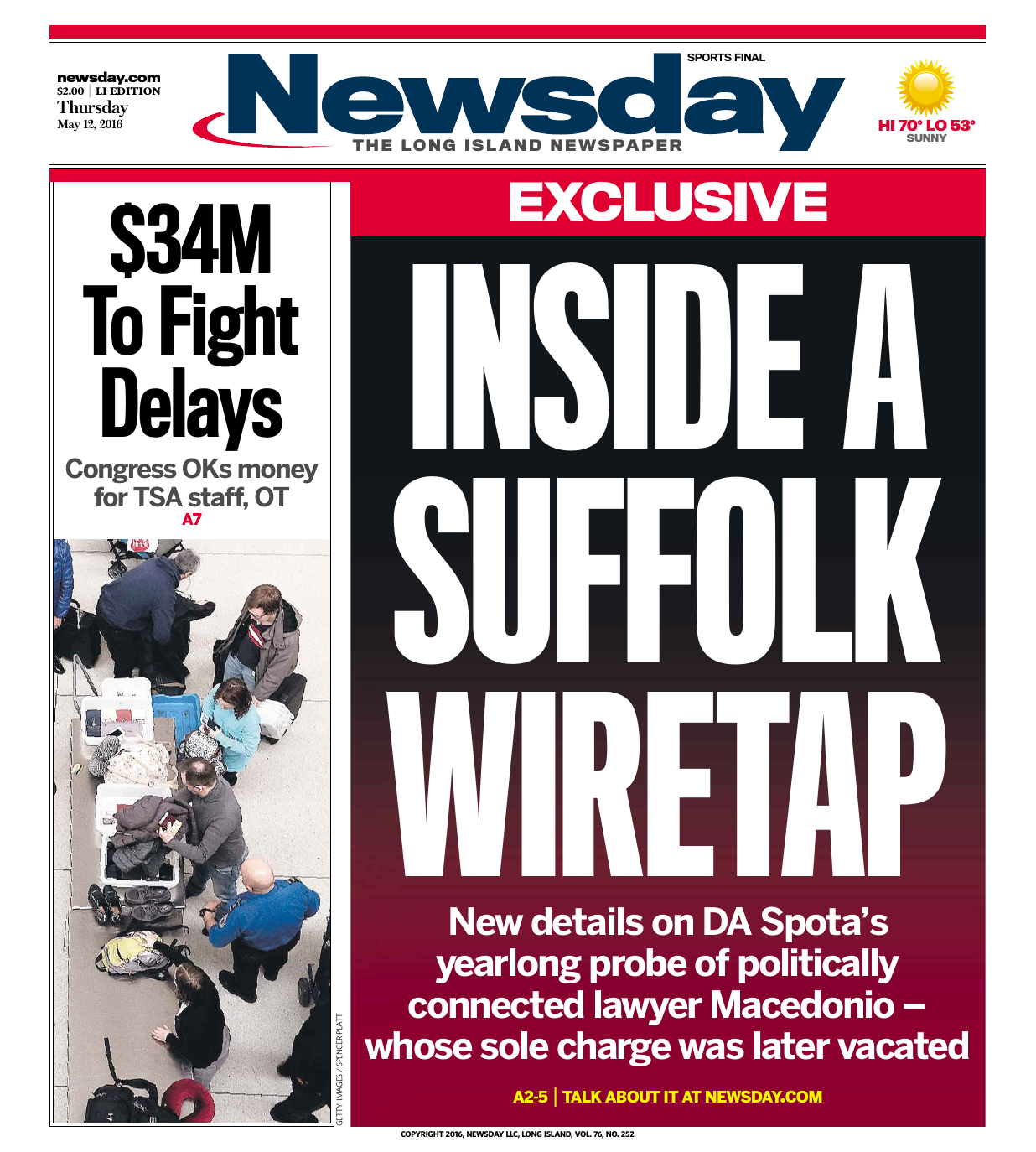
- Newsday, February 8, 2016. “Macedonio felony cleared in a case shrouded in secrecy”.
- Newsday, May 12, 2016. “Inside a Suffolk Wiretap”, including its description of the original investigation and uncharged conduct.
- Newsday, March 11, 2016. Federal subpoenas seek the Macedonio wiretap files.
- Newsday, April 26, 2016. Reporting concerning Prudenti, the Christina Marie, payments, influence, and potential conflicts.
- Newsday, May 13, 2016. Bellone’s resignation demand, Spota’s response, and the competing political accusations.
- Newsday, May 27, 2016. “4 Cops Leave DA Unit,” reporting the four transfer requests and concerns about the integrity of cases handled under McPartland.
- Newsday, October 26, 2017. Spota and McPartland indicted in the Burke cover-up.
- Newsday, October 27, 2017. Spota announces that he will leave office.
- Newsday, December 7, 2018. Court papers detail the alleged obstruction plan.
- Newsday, December 26, 2018. Court records describe meetings, telephone evidence, witness pressure, and alleged concealment.
- Newsday, November 27, 2019. Hickey’s trial testimony concerning the search for the person who talked and warnings involving “The Administration”.
- Newsday, December 12, 2019. Closing arguments and the competing prosecution and defense accounts.
- Newsday, December 18, 2019. The federal jury’s guilty verdicts.
- Newsday, December 22, 2019. Trial testimony and the reported culture of fear, retaliation, and concentrated power.
- Newsday, August 11, 2021. Sentencing of Spota and McPartland.
- U.S. Attorney’s Office, Eastern District of New York, August 10, 2021. Official sentencing record.
- U.S. Attorney’s Office, Eastern District of New York, December 9, 2015. Official record of Burke’s indictment, arrest, and arraignment.
- U.S. Attorney’s Office, Eastern District of New York, February 26, 2016. Official record of Burke’s guilty plea.
Read the reporting behind the story.
Each source is presented with a full first-page preview, a meaningful title, and a short explanation of what it adds to the chronology. Select any thumbnail or link to open the preserved PDF.
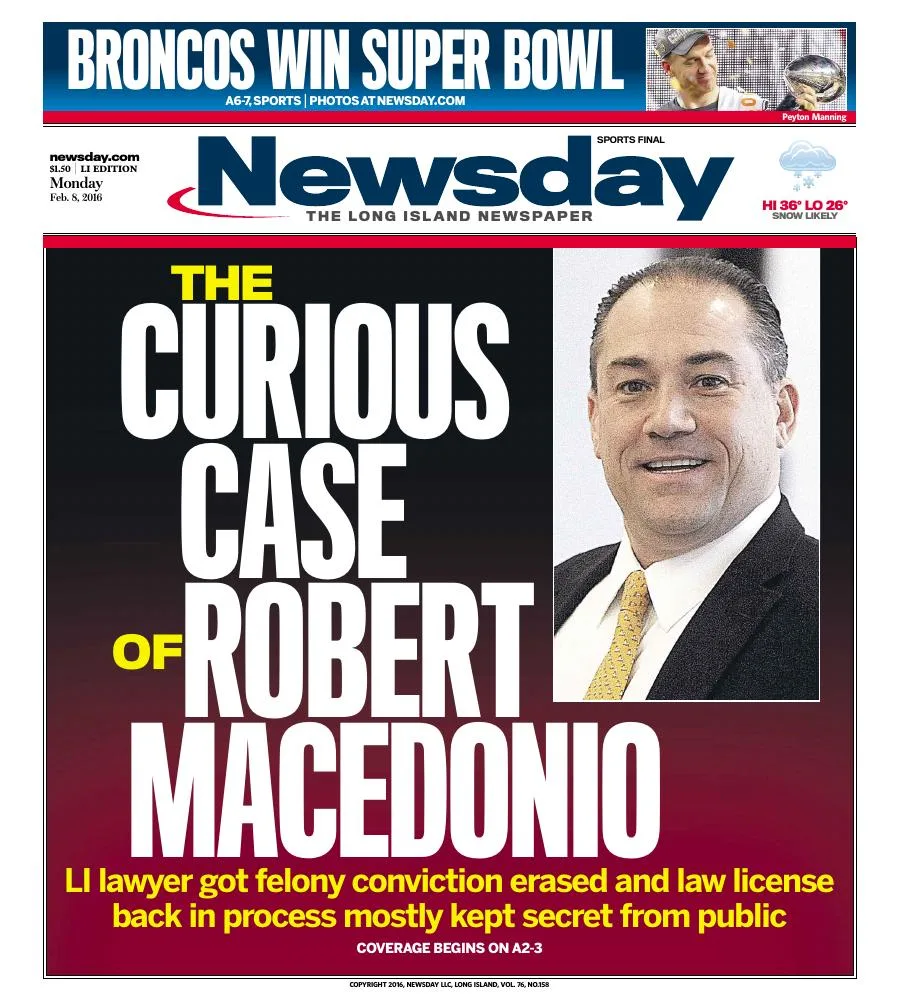
Macedonio felony cleared in a case shrouded in secrecy
The opening investigation reconstructed the broad financial and narcotics case, the felony plea, the later misdemeanor substitution, and the sealed public record.
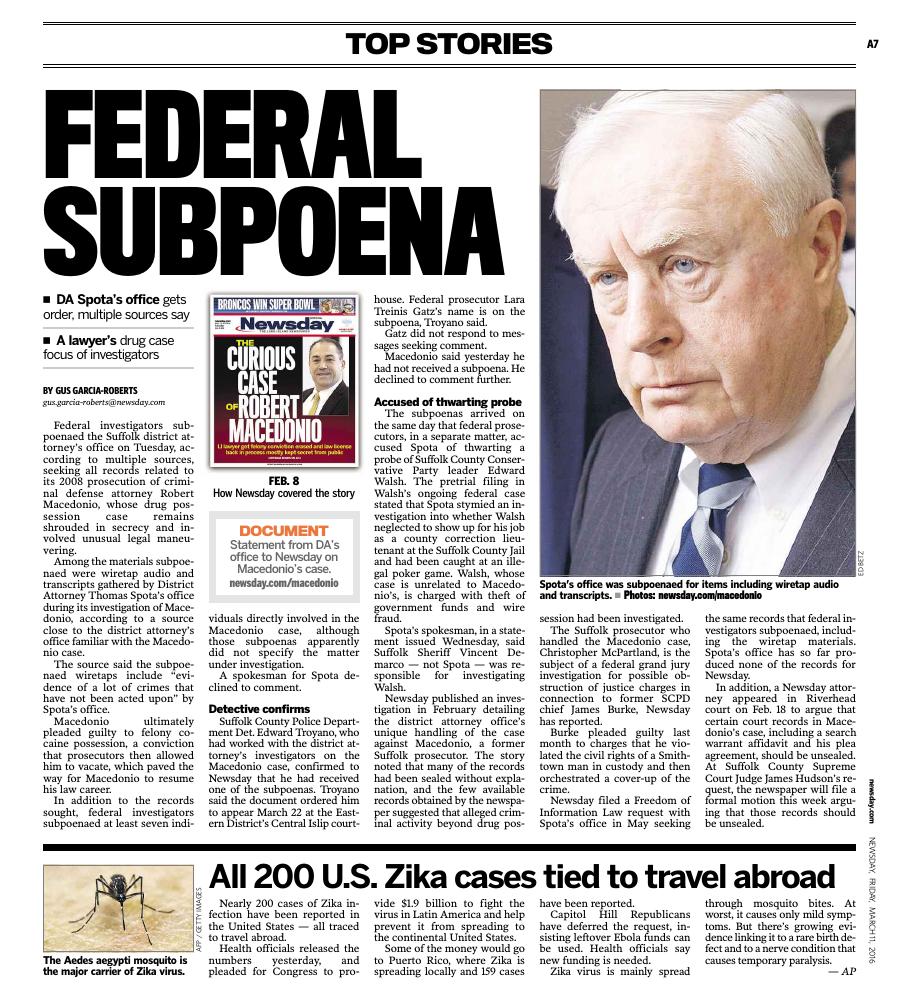
Federal subpoenas seek the Macedonio wiretap files
Newsday reported that federal investigators demanded the district attorney’s case file, including wiretap audio and transcripts, and subpoenaed people connected to the original investigation.
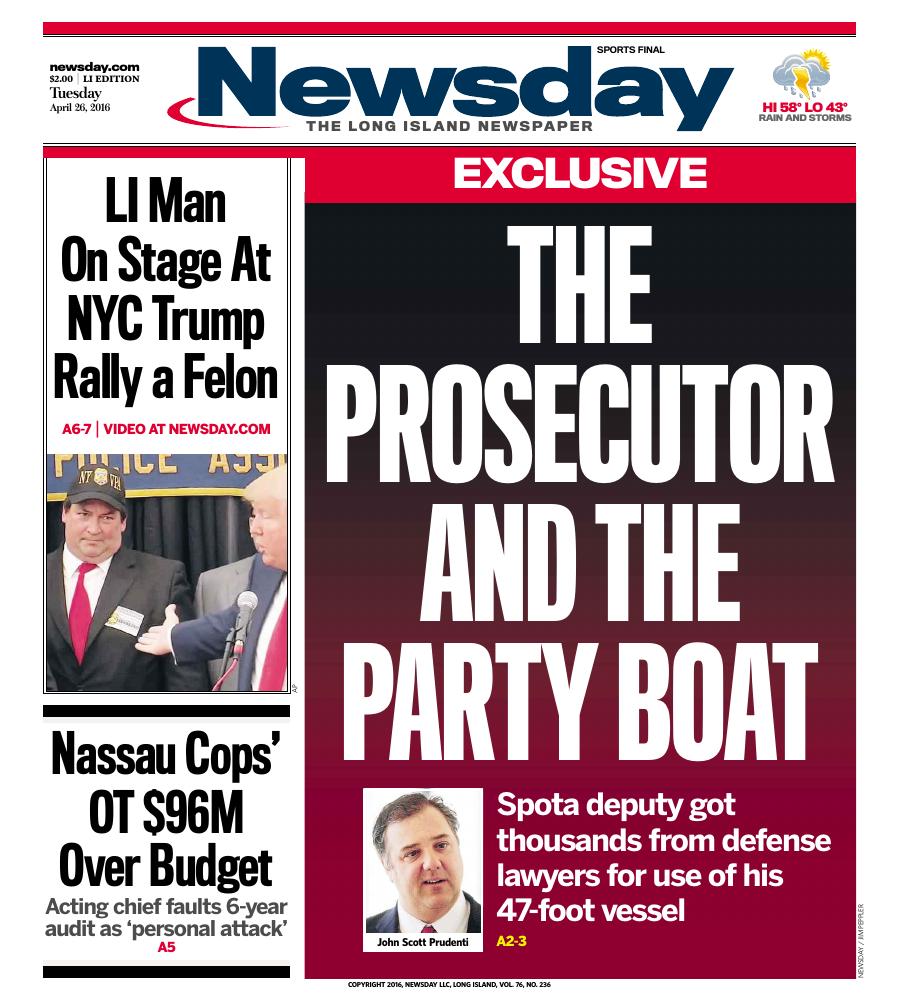
A prosecutor’s party boat and questions of influence
Defense attorneys described paying prosecutor John Scott Prudenti for parties and fishing trips. Some characterized the arrangement as a way to curry favor. Others and the district attorney’s office disputed that interpretation.
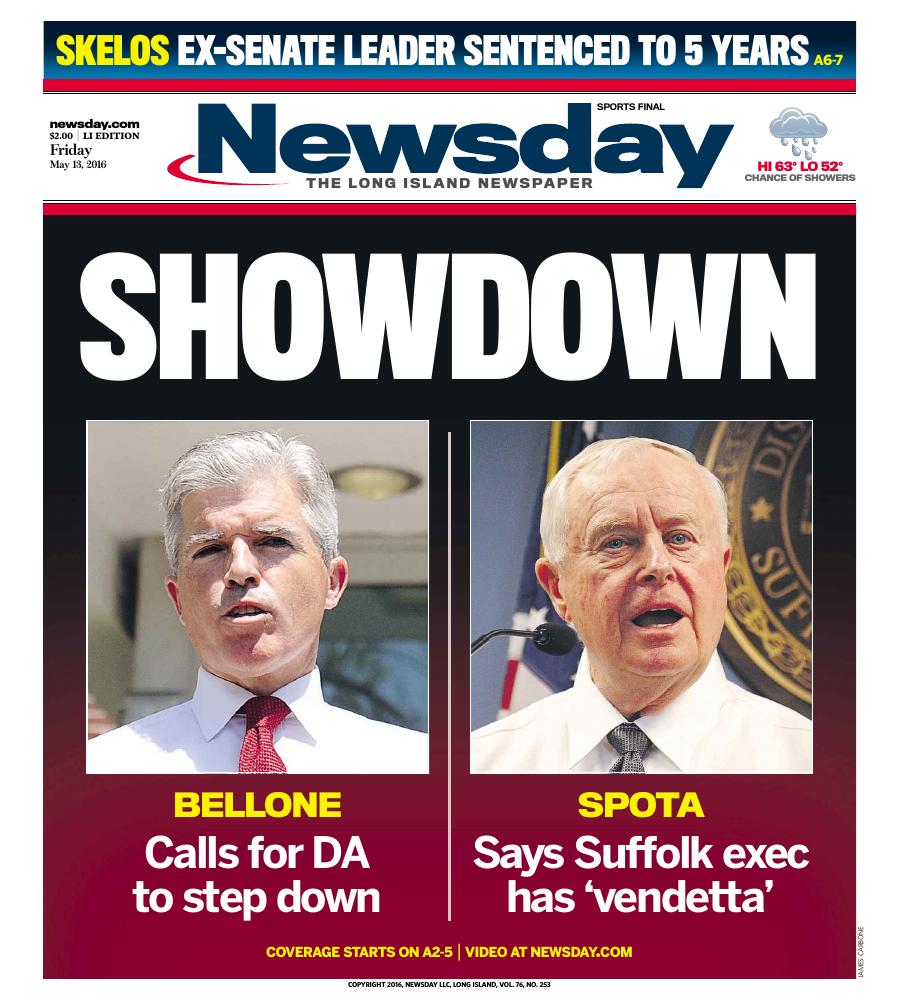
Bellone calls for Spota to resign as the political conflict erupts
County Executive Steve Bellone cited reports of possible crimes heard on wiretaps but not prosecuted. Spota denied wrongdoing and accused Bellone of a political vendetta.
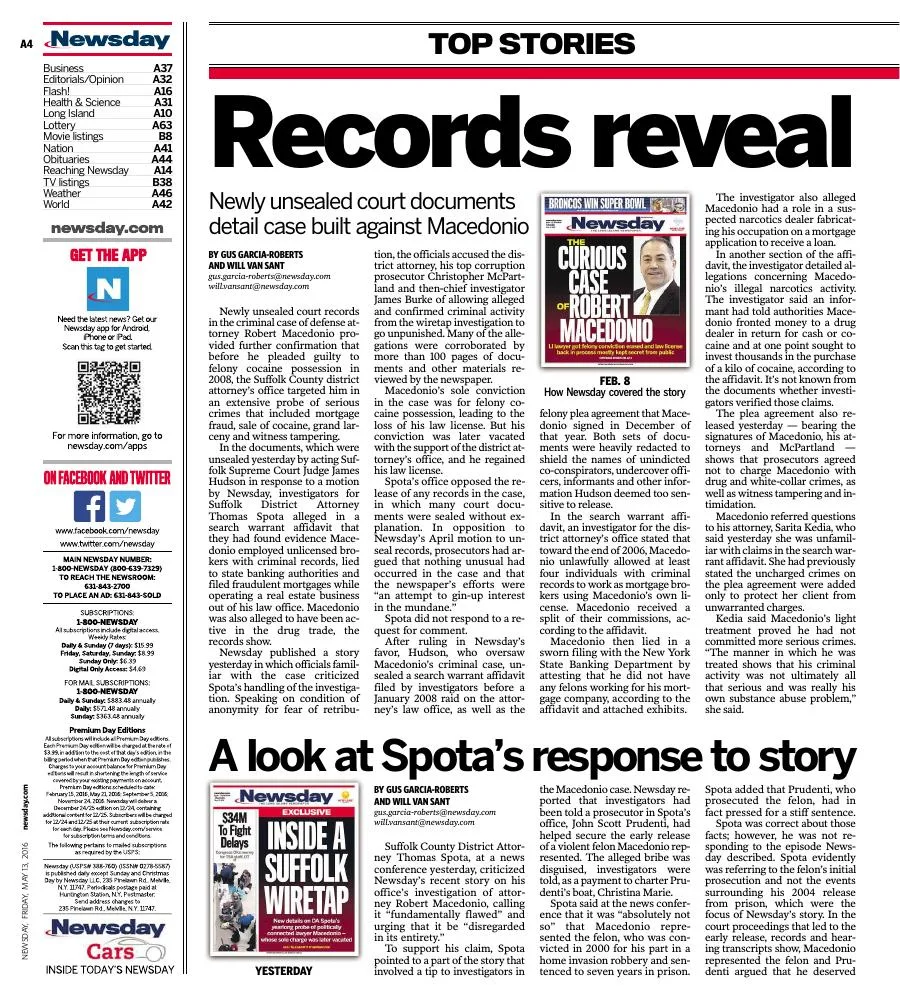
Unsealed records confirm the breadth of the Macedonio investigation
Newly released documents described mortgage, drug, larceny, and witness-related allegations and detailed the charges prosecutors agreed not to bring under the plea arrangement.
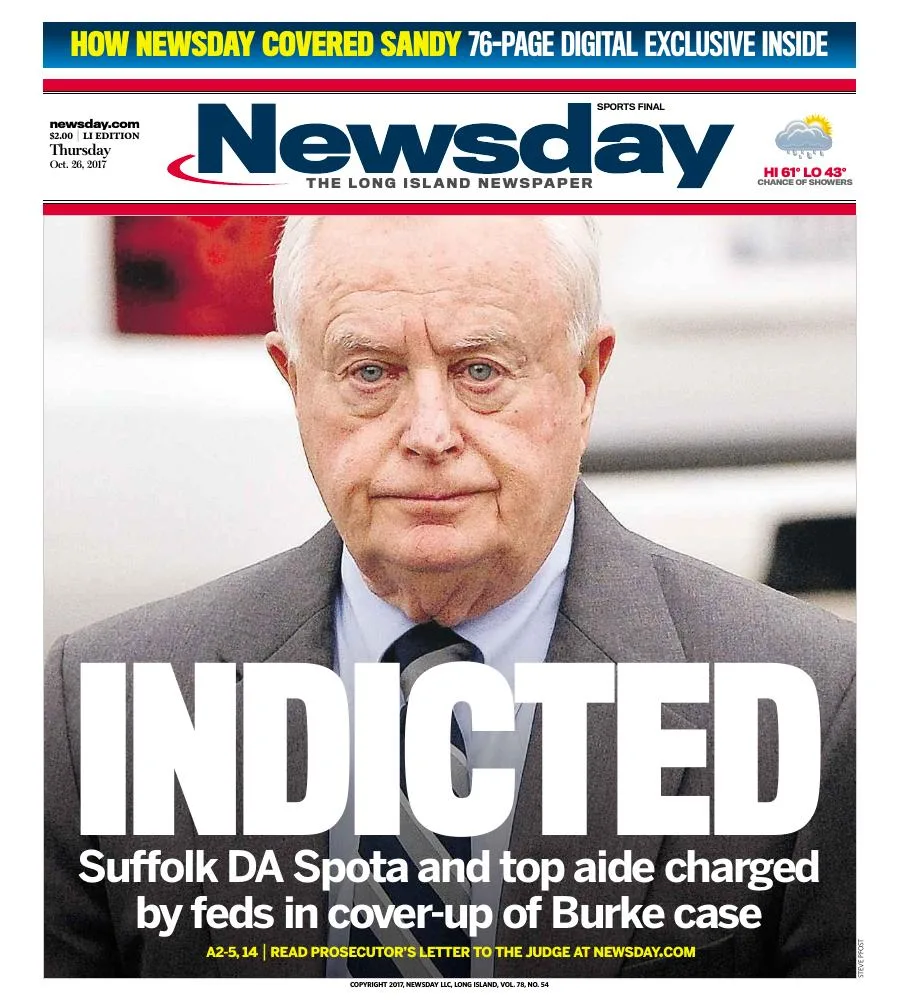
Spota and McPartland indicted in the Burke cover-up
Federal prosecutors charged Suffolk’s district attorney and his corruption-bureau chief with obstruction, witness tampering, and concealing James Burke’s assault of Christopher Loeb.
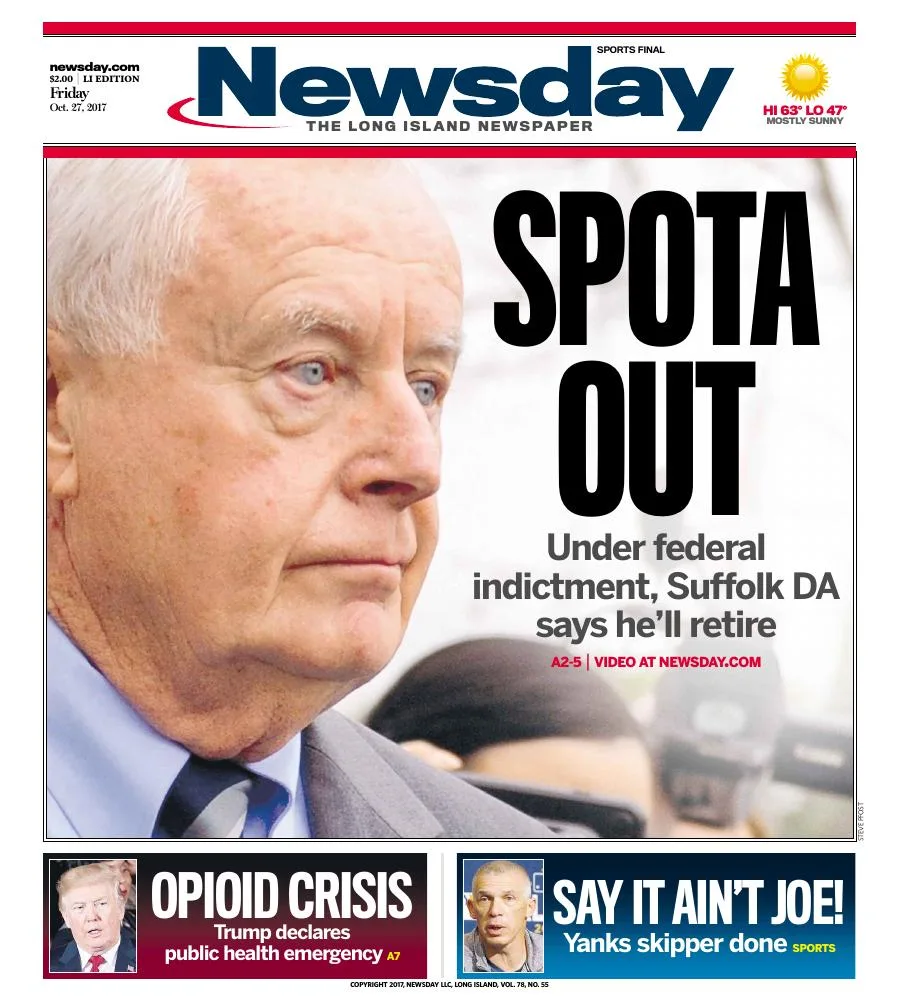
Spota announces that he will leave office
One day after the federal indictment, Spota announced his retirement while denying the criminal charges. The coverage examined the immediate political and institutional transition.
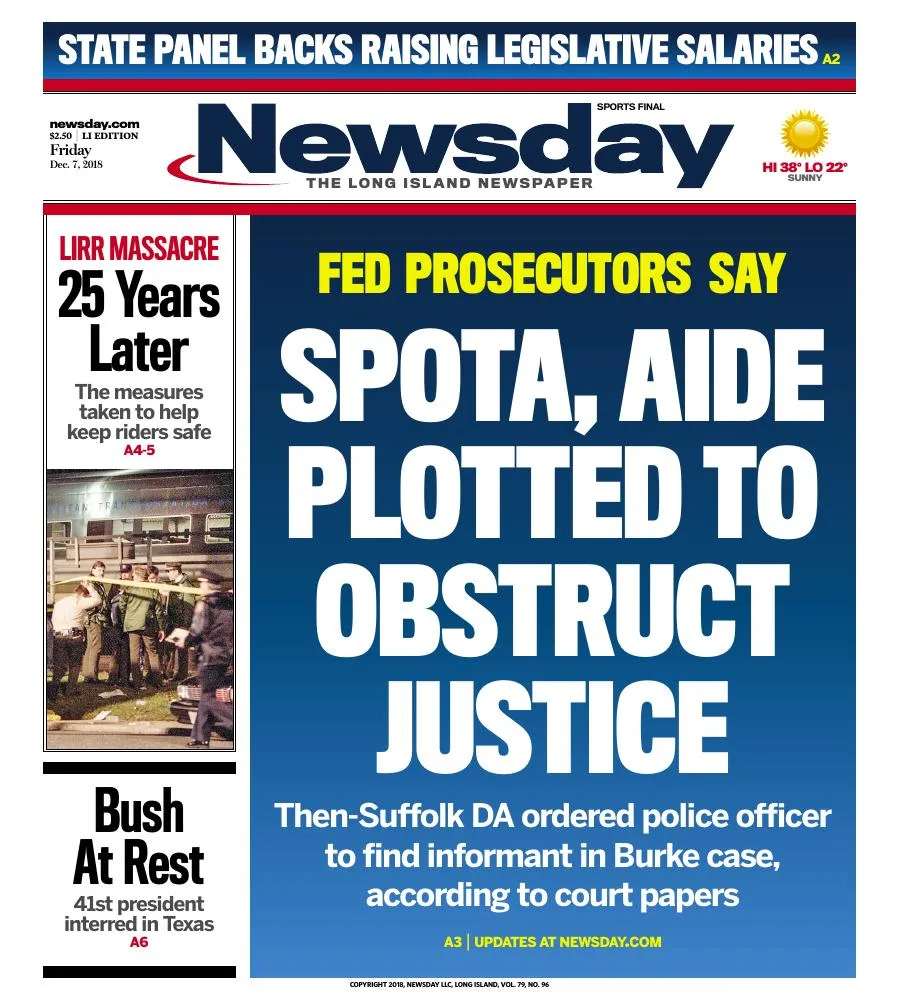
Court papers detail the alleged obstruction plan
Pretrial filings described efforts to identify a federal informant, influence witnesses, control information, and coordinate responses to the reopened civil-rights investigation.
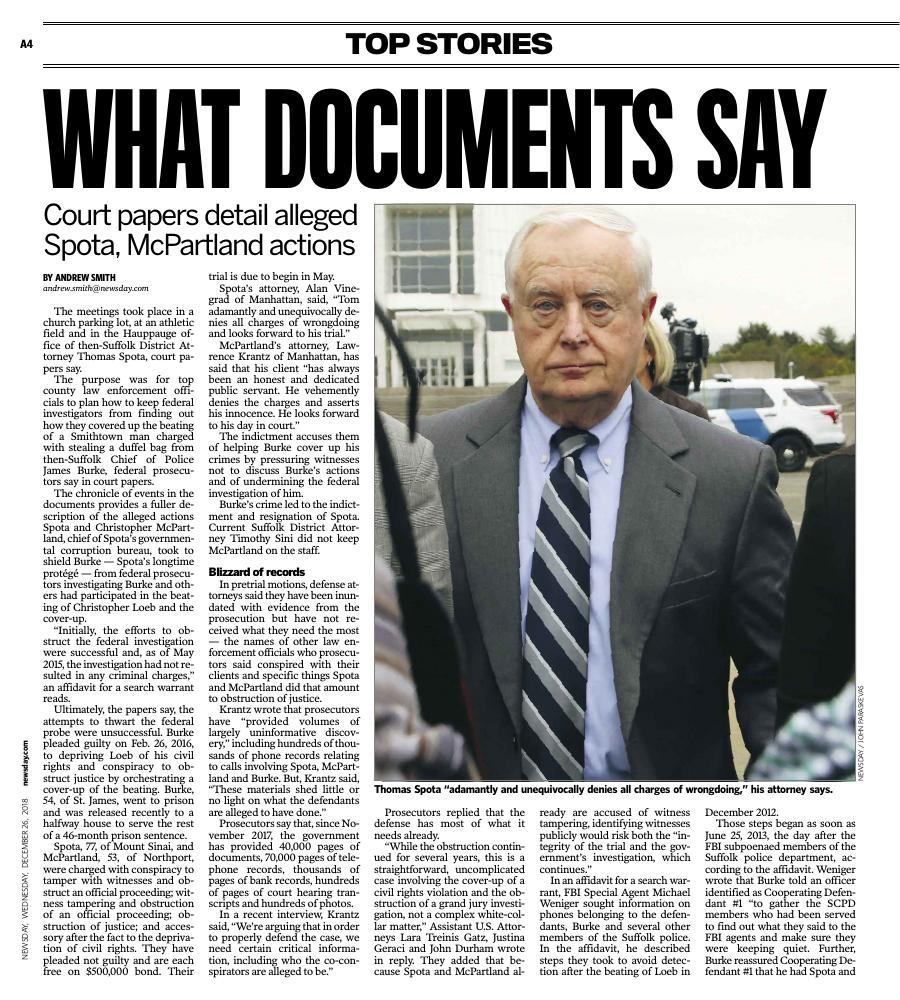
A fuller account of meetings, records, and alleged concealment
Search-warrant affidavits and court papers supplied a more detailed chronology of meetings, telephone evidence, witness pressure, and alleged money provided for legal expenses.
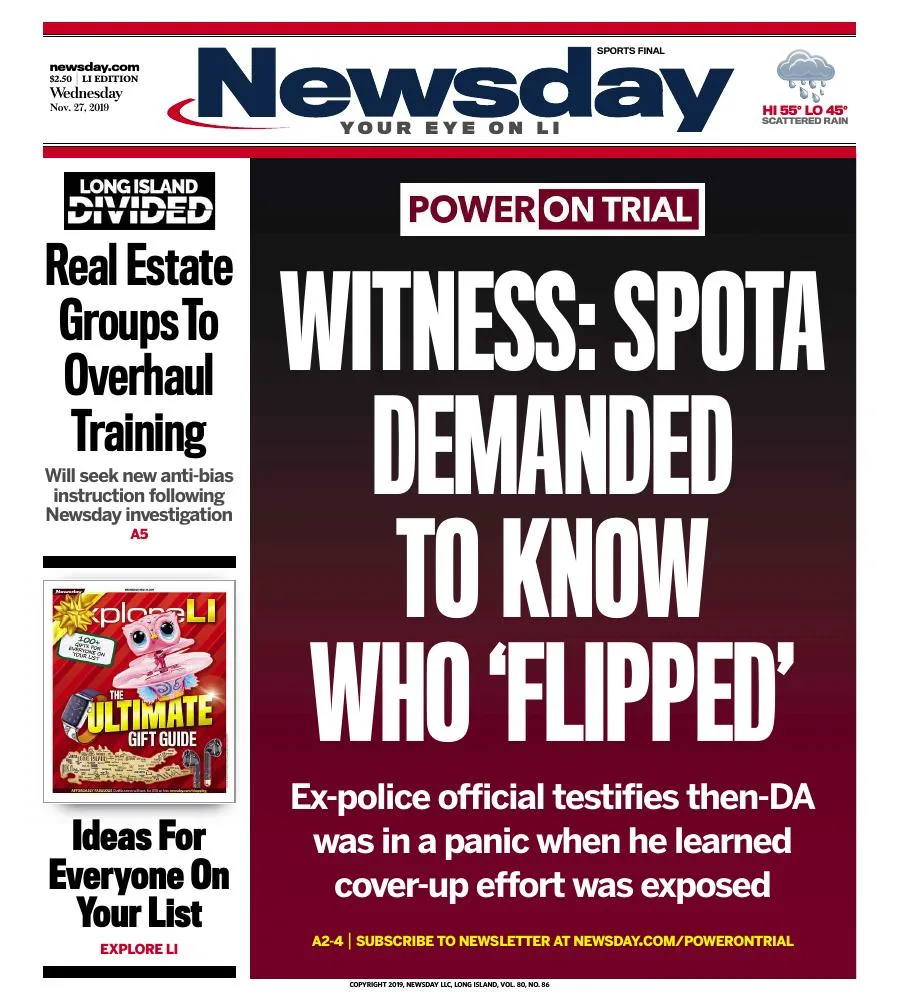
A witness describes the search for the person who talked
At trial, former police lieutenant James Hickey testified about the reaction to the reopened federal investigation and alleged threats against anyone cooperating with authorities.
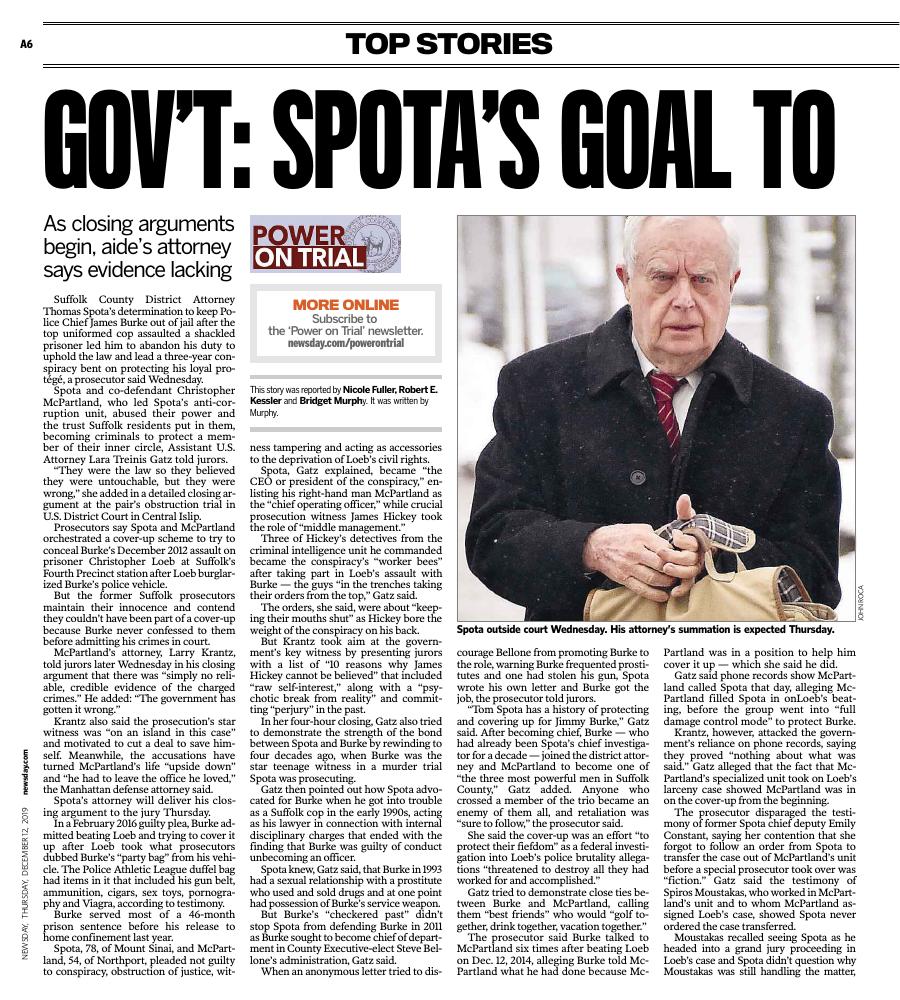
Closing arguments define the prosecution and defense accounts
Prosecutors described a leadership-driven conspiracy to protect Burke. Defense counsel attacked the credibility of the government’s central witness and argued that the evidence was insufficient.
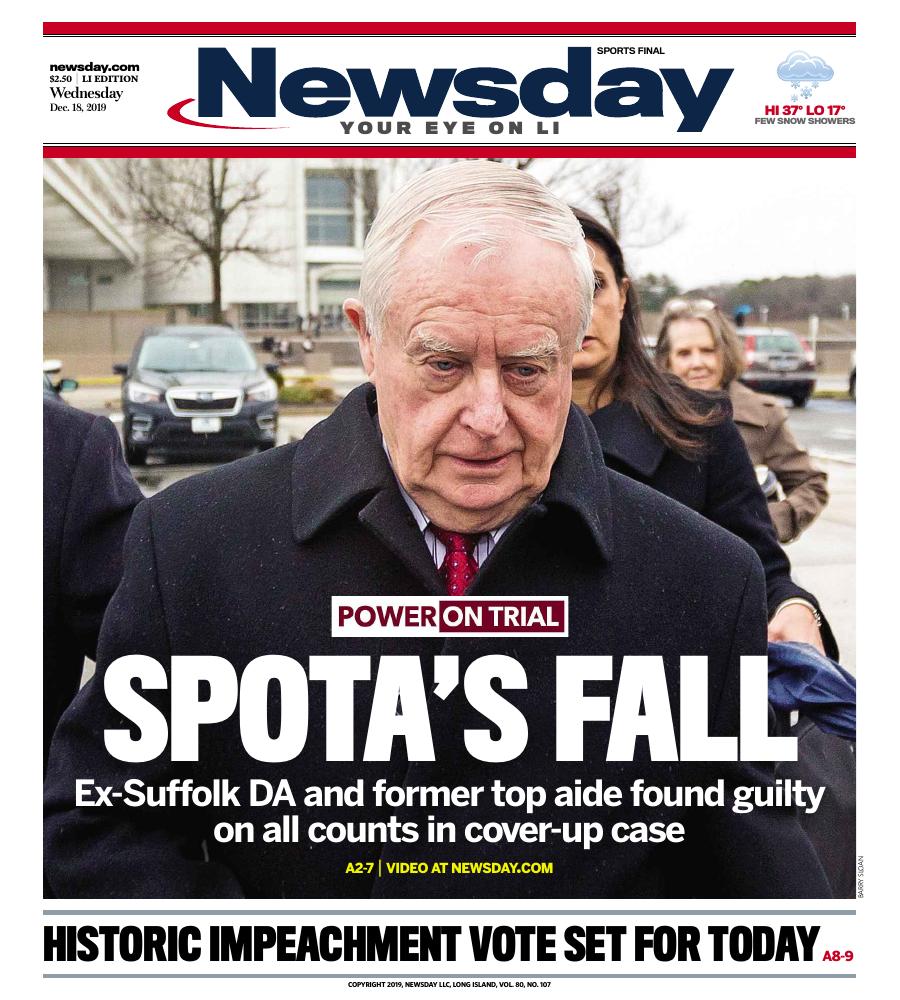
Spota and McPartland convicted on all counts
After a six-week trial, the federal jury returned guilty verdicts for conspiracy, obstruction, witness tampering, and accessory-after-the-fact liability.
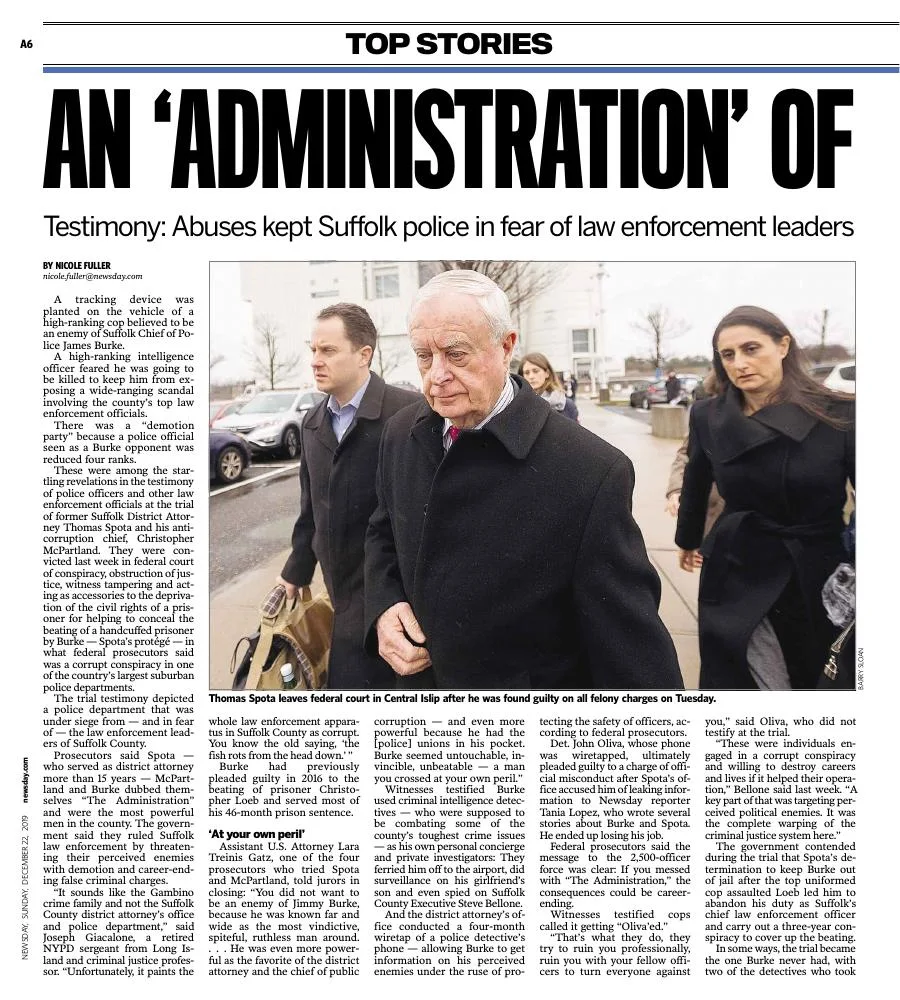
Trial testimony describes a law-enforcement culture of fear
A retrospective account collected testimony about retaliation, surveillance of perceived enemies, career threats, and the concentration of power described during the federal trial.
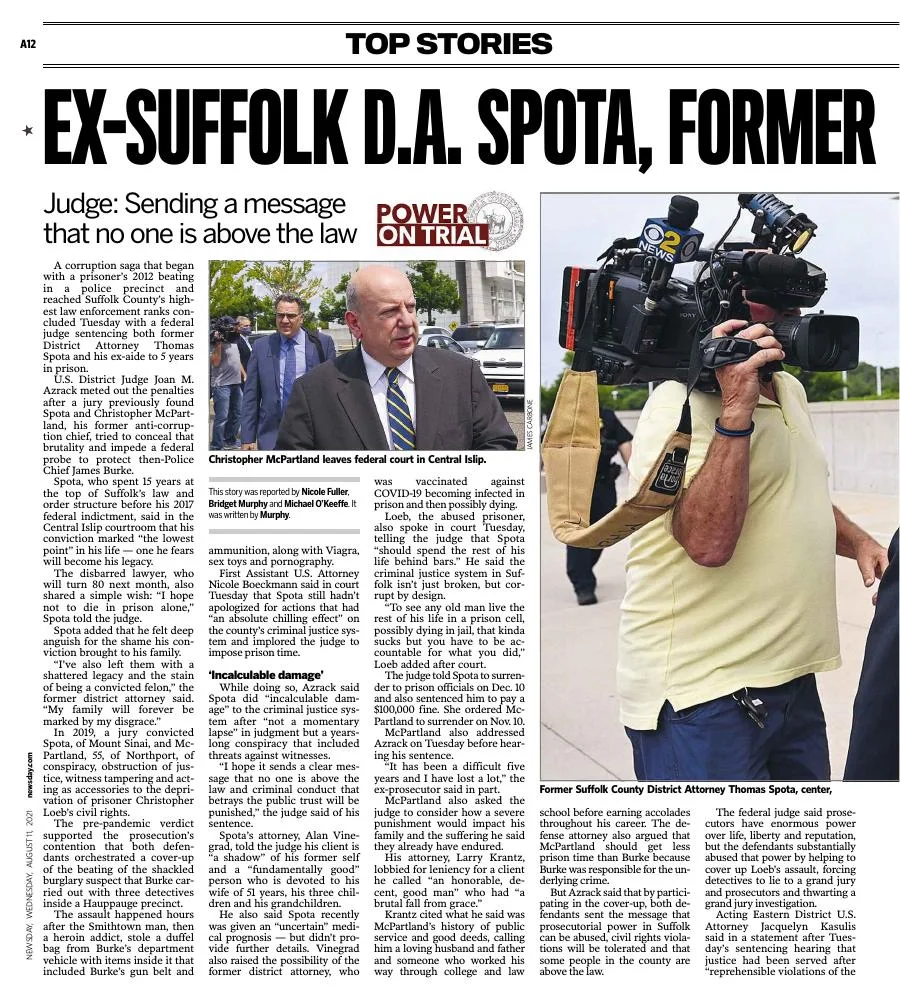
Five-year federal sentences close the documented chronology
A federal judge sentenced Spota and McPartland to five years in prison and emphasized the damage their conduct caused to public trust and the criminal justice system.
Complex evidence requires more than one discipline.
Royal Palm Investigations supports attorneys when communications, phone records, digital evidence, surveillance, witnesses, and institutional decision-making must be reconstructed as one defensible case record.
When the record is complicated, the investigation must be clear.
Royal Palm Investigations provides attorney-directed investigative support for serious criminal matters involving wiretaps, electronic evidence, phone records, surveillance, and contested investigative conclusions.