
U.S. v. Spatafora: Inside the Wiretap Record

He called himself “Junior Gotti.” The wire captured what came next.
Robert Spatafora operated at the intersection of organized crime, cocaine dealing, and an illegal sports book. Behind it was the unresolved killing of Peter Ghattas outside the earlier Rob’s Pro Tow location—a homicide investigation that had gone cold for years. The business later moved, and the Suffolk County wiretap covered the newer location. When that wire created an opportunity to seek evidence, investigators orchestrated an arrest to look routine and lightly touched the old nerve. The monitored calls erupted. Spatafora repeatedly accused Jane Doe of working with the FBI, giving investigators information, and helping build a case against him. Those accusations escalated into death threats. Christopher Rizzi served as lead investigator and wiretap coordinator.
The May 17, 2010 affidavit states that attributed statements are described only “in sum and substance and in part,” and that its summaries rely on draft transcripts subject to revision. The affidavit therefore reports the agent’s account of the intercepted language; the October 1 plea transcript separately records Spatafora’s sworn admissions.
Robert Spatafora owned and operated Rob’s Pro Tow, an auto-repair and towing business at 556 Rosevale Avenue in Ronkonkoma, New York. The federal sentencing court identified him as an associate of both the Colombo and Lucchese organized-crime families. In 2010, he was monitored on a Suffolk County wiretap and became the defendant in the federal case examined here. On October 1, 2010, he pleaded guilty to cocaine conspiracy, witness tampering, and operating an illegal sports-betting business. He was later sentenced to 41 months in prison and three years of supervised release. The sentencing opinion also recorded the government’s position that he remained a suspect in the unresolved killing of Peter Ghattas. Spatafora denied involvement, and the court made no homicide finding.
Each stage answers a different question.
The May 17, 2010 arrest-warrant affidavit is the investigative record. FBI Special Agent John P. Burns described the Ghattas homicide investigation, FBI interviews, and calls intercepted on a Suffolk County wiretap. Its quotations are powerful, but its legal posture matters: the filing presented probable-cause allegations and the agent’s interpretations, not a homicide finding.
Rizzi’s firsthand account supplies operational context the affidavit does not fully describe: how detectives orchestrated Jane Doe’s warrant arrest to appear routine, what Rizzi and his partner, Detective Gang, said within her hearing, what they did not tell her, and why covert surveillance was later assigned for her protection. Those details are identified as Rizzi’s recollection—not as separate judicial findings.
The May 19 detention hearing records the adversarial arguments over risk, proof, and the proposed bail package. The October 1 plea transcript records Spatafora’s admissions under oath. The sentencing opinion fixes the adjudicated outcome while preserving the unresolved boundary surrounding the Ghattas homicide.
FBI records and contemporaneous reporting provide the larger organized-crime context and the “Junior Gotti” description. They are used for that history without merging separate indictments or turning reported allegations into findings.
Cocaine conspiracy, witness tampering, and operating an illegal sports-betting business—each with its own time period and elements.
Rizzi served as lead investigator and wiretap coordinator, organizing intercepted communications and tying calls to speakers, events, and corroborating evidence.
The court found by clear and convincing evidence that no combination of conditions could adequately assure community safety.
The unresolved Ghattas investigation had gone cold for years. Investigators used the Suffolk County wiretap as an opportunity to seek new evidence. No homicide charge or finding followed.
The record illustrates why intercepted language must be attributed, sequenced, corroborated, and separated from agent interpretation and later adjudicated facts.
Years after the Ghattas investigation went cold, the wire created a new opening.
The story begins outside Rob’s Pro Tow in 2003, not in a wire room. The early homicide work did not resolve Peter Ghattas’s killing, and the investigation went cold for years. Rob’s Pro Tow moved after the murder; the later wiretap coverage involved the newer location. When a Suffolk County wiretap was operating in an organized-crime, cocaine, and gambling investigation, Rizzi and the investigative team recognized an opportunity to revisit the homicide theory and seek new evidence. That is the context for the staged-to-look-routine arrest—and the cascade of calls that followed.
A tow-truck operator was found shot to death outside the shop where he worked.
The affidavit opens its factual narrative seven years before the arrest warrant. It states that Peter Ghattas, thirty-five, was discovered shot to death outside Rob’s Pro Tow at 556 Rosevale Avenue in Ronkonkoma, New York. Spatafora owned and operated the auto-repair business. Ghattas worked there as a tow-truck operator.
Rizzi recalls that Ghattas was not providing only generalized information about criminal activity. He was supplying investigators with information about a large-scale narcotics-trafficking operation and a related burglary crew. That distinction matters: the homicide investigation began against a background of drug distribution, firearms, burglaries, cooperating-source information, and relationships that crossed the same group of people.
One person in that investigative circle was Eddie Wright, whom Rizzi identifies as a Spatafora associate involved in narcotics trafficking. Wright was prosecuted separately in the Eastern District of New York. The federal opinion in U.S. v. Wright records guilty pleas to a cocaine-and-crack conspiracy, two substantive narcotics counts, and three firearms offenses. It records concurrent 480-month terms on the principal narcotics counts plus a consecutive 60-month firearms term—an aggregate sentence of 540 months, or 45 years. The Second Circuit affirmed the judgment in April 2011.
The 556 Rosevale Avenue address was the 2003 homicide scene and the location where Ghattas had worked. Rob’s Pro Tow later moved. The Suffolk County wiretap and the wiretap-era business activity described later in this story involved the newer location—not the site where Ghattas was killed. What carried forward was the business, its owner, and the relationships surrounding it, not the physical address.
The affidavit did not establish who killed Ghattas. It explained why investigators continued returning to the people and relationships connected to the business and why the later telephone reactions drew their attention.
“On September 24, 2003, a 35-year-old man named Peter Ghattas was discovered shot to death outside Rob’s Pro Tow, an auto repair shop located at 556 Rosevale Avenue, Ronkonkoma, New York.”
The homicide remained unresolved. Nothing in the affidavit, the later plea, or the sentencing record amounted to a homicide conviction or judicial finding against Spatafora.
The affidavit said Ghattas had admitted providing information to police.
For a period of time, the affidavit states, Ghattas served as a confidential source for the Suffolk County Police Department. Approximately one week before his death, Ghattas reportedly told SCPD members that Spatafora had questioned him about his contacts with law enforcement. According to the filing, Ghattas said he admitted to Spatafora that he had been supplying information about criminal activity in Suffolk County.
A footnote added another piece of background: in September 2002, Ghattas had pleaded guilty in Suffolk County Court to attempted burglary in the second degree and received five years of probation. The affidavit did not say that conviction explained his death. It separately reported his criminal case, his confidential-source status, and what he reportedly told police before the killing.
“Approximately one week before his death, Ghattas told members of the SCPD that Spatafora had questioned him about his interactions with law enforcement. Ghattas said that he had admitted to Spatafora that he had been providing law enforcement with information about criminal activity in Suffolk County.”
Spatafora offered detectives two possible explanations for Ghattas’s death.
More than a year after the killing, SCPD detectives interviewed Spatafora at his shop. The affidavit says Spatafora told them he knew Ghattas had been cooperating because Ghattas told everyone what he was doing. He then suggested two possible explanations for the killing: Ghattas’s involvement with people committing burglaries or a romantic relationship.
Jane Doe, identified in the filing as Spatafora’s girlfriend, was present for that interview. The affidavit did not present Spatafora’s suggestions as established causes of death. They were his reported statements during a homicide interview.
“Spatafora knew Ghattas had been cooperating with law enforcement because Ghattas told everyone what he was doing.”
“Spatafora suggested Ghattas may have been killed either as a result of Ghattas’ involvement with other individuals committing burglaries, or as a result of a romantic relationship.”
The interview did not resolve the homicide. Over the years that followed, the Ghattas investigation went cold. When Spatafora later became the subject of a Suffolk County wiretap, Rizzi and the investigative team recognized a rare opportunity to revisit the old case and seek new evidence without announcing that renewed interest.
Spatafora called himself “Junior Gotti.” The investigation placed him in the orbit of two crime families.
By the time the Suffolk County wiretap began, Rob’s Pro Tow had moved from the location where Ghattas was killed. The wiretap coverage and the later business activity involved the newer shop. The monitored environment included cocaine transactions, an illegal sports-betting business, organized-crime relationships, and the people moving through that location.
A contemporaneous New York Post account described Spatafora as a thirty-eight-year-old garage owner “who calls himself ‘Junior Gotti.’” The label was not assigned by detectives. It was a name he used for himself, and it revealed something important about how he saw his own place in that world.
The sentencing opinion identified Spatafora as an associate of both the Colombo and Lucchese families of organized crime. The court’s exact word was “associate”—not boss, captain, or made member. The organized-crime connection supplied context, but the case still depended on proof of particular calls, transactions, wagers, relationships, threats, and admissions.
“Association with organized crime cannot be countenanced.”
Rizzi served as lead investigator and wiretap coordinator for a Suffolk County wiretap on Spatafora. That meant organizing the intercepted calls by speaker and event, separating cocaine evidence from gambling evidence, and matching the words on the telephone to people, vehicles, meetings, money, and activity outside the wire room. Read the preserved New York Post account of the “Junior Gotti” description.
The repair shop became a delivery point, and the telephone became the broker’s desk.
The repair shop described in the wiretap-era cocaine evidence was the newer business location, not the 556 Rosevale Avenue homicide scene. The sentencing court described conduct more specific than a generic drug-conspiracy label: Spatafora used his auto-repair business to receive cocaine deliveries. By telephone, he connected suppliers with buyers and negotiated particular prices and quantities for friends, employees, and acquaintances.
The transactions varied in scale. The court wrote that some purchases involved amounts worth as little as $100. On another occasion, Spatafora loaned a coconspirator $5,000 to purchase cocaine. The plea record added the longer pattern: repeated distribution transactions during the wiretap period, an estimated total of 200 to 300 grams, and Spatafora’s admission that he acted between suppliers and recipients.
“Defendant used his business to receive deliveries of cocaine.”
For the investigative team, every call still had to be made concrete. A speaker, price, quantity, supplier, recipient, delivery point, and event could not be treated as interchangeable. Rizzi’s work as lead investigator and wiretap coordinator required keeping the transactions separated by person and then connecting each pertinent call to the larger chronology.
Telephone wagers, a Costa Rica website, collectors—and the man who said he ran it.
Count Five concerned an illegal sports-betting business that operated for more than thirty days, involved at least five people, and generated at least $2,000 in gross revenue on a single day. The court described two doors into the book: traditional wagers placed by telephone and a website registered in Costa Rica. Although the site presented itself as being for entertainment, registered users could wager money on sporting events.
The online system did not remove the street-level work. Bets had to be received, accounts managed, money collected, and winners paid. The sentencing opinion said Spatafora used acquaintances to collect gambling debts from bettors. At the plea hearing, the prosecutor described him as managing the operation, taking bets and money, paying winners, and controlling the business. Spatafora agreed.
“I guess I ran it. I don’t know the right word. I don’t know what you want me to say.”
The gambling and cocaine conduct crossed the same business and telephone environment, but they were not the same proof. Wagers, account activity, settlements, and debt collection belonged to the sports book. Supplier calls, price negotiations, deliveries, and recipients belonged to the cocaine conspiracy. The investigation had to preserve both the connection and the separation.
Detectives used an existing warrant to stage an arrest that would look routine.
Jane Doe had an active Suffolk County District Court bench warrant. The detectives deliberately used it to create a controlled opportunity: uniformed SCPD officers would make the arrest in the ordinary manner, and nothing about the arrest itself would disclose the wiretap or the investigators’ purpose. From Jane Doe’s perspective—and from anyone she later spoke with—it was meant to look like a normal warrant arrest.
During processing, Christopher Rizzi and his partner, Detective Gang, briefly entered the room and looked at the arrest paperwork. One of them noticed the employer line and asked, in substance, “You work at Rob’s Pro Towing—that’s Rob Spatafora, right?” Jane Doe answered yes.
The two detectives then spoke only to one another, within her hearing. They recognized Rob’s Pro Towing as the place where Peter Ghattas had been found murdered and noted that the homicide remained open. They did not question Jane Doe about Ghattas. They did not tell her Spatafora was being followed. They did not disclose that his telephone was being intercepted. They only mentioned the murder, then left the room.
It was a classic effort to “tickle the wire”: introduce a small, controlled stimulus and watch for a reaction on the monitored telephone. The theory was that if Spatafora feared Jane Doe could disclose information implicating him, she would repeat the brief exchange and he would respond where investigators could hear it.
Jane Doe was released. Then the telephone carried Spatafora’s version of what had happened.
At approximately 11:48 a.m. the next day, SCPD intercepted an incoming call on a telephone registered to Rob’s Pro Towing and used by Spatafora. The caller used a telephone the affiant believed belonged to Spatafora’s former wife. They discussed Jane Doe’s arrest and what Spatafora claimed detectives had said.
Spatafora: “[They were] asking her about Pete, all crazy shit, saying they know what I do, they’re on to me. So if you know what [I] do, what are you asking her for, and I don’t do nothing, so what the fuck are you talking about? It’s just sickening.”
Hickey: “Now who was this? The detectives?”
Spatafora: “Yeah. On the murder case.”
Spatafora then said detectives had told Jane Doe they “follow me everywhere and have my phones tapped.” The recording accurately captured him making that claim. Rizzi’s firsthand account is different: investigators said neither thing. The assertion came from Spatafora, not from the processing-room conversation.
“Obviously, so they figured they’d pressure her while she’s there, but I don’t do nothing, like, as if she’s gonna turn around and say yeah, Rob murdered Pete, like it’s so fucking retarded. Like give me a fucking break.”
Burns wrote that he understood “Pete” as Peter Ghattas. That was the agent’s interpretation in a probable-cause affidavit, not a homicide finding. Investigatively, the important fact was the reaction itself: after a minimal stimulus, Spatafora supplied details investigators had not told Jane Doe and described fears they had not placed in her mind.
The arrest produced no homicide statement from Jane Doe. What it exposed was Spatafora’s fear that she might talk. From this point forward, the calls show that his trust in her was broken. He no longer treated her simply as a longtime partner and employee; he treated her as someone close enough to the investigation to give detectives information.
Each new interview tightened the circle around the monitored subjects.
During April and May, Burns wrote, FBI agents and SCPD officers interviewed people believed to possess information about the Ghattas homicide and related crimes. Rizzi identifies the April 28 interview team as Burns, Rizzi, and Burns’s partner. They interviewed Nicky Motta that afternoon.
Immediately afterward, SCPD intercepted a call from Jane Doe to Spatafora:
Jane Doe: “Do not come back here. Call Nicky Motta right away and meet him somewhere. They just went for him so call him right now.”
Later that evening, Spatafora spoke with his former wife while Motta and another person were near the telephone.
“He had me shittin’ like as if they fuckin’ nailed me for fuckin’ ten murders.”
The next call captured Motta in the background. The affidavit used “[UI]” for an unintelligible portion of the audio:
Motta: “Now they want to link it. . . . [UI] that happened at his shop.”
Spatafora: “100 percent not. I can guarantee that.”
None of those statements established ten murders or any homicide. They showed how quickly interview activity moved through the network and onto a monitored line. Jane Doe warned Spatafora immediately after the Motta interview, but the later calls show that the warning did not restore his trust in her. Instead, every new contact with investigators reinforced his fear that she might be giving them information.
This is where surveillance, interview timing, speaker attribution, and call sequencing give isolated words their investigative meaning. March 31 captured the first reaction. April 28 showed the pressure spreading through the people around him. The May 11 calls would show what that pressure had become.
On May 11, the fear of cooperation broke into explicit threats.
The May 11 calls no longer sounded like an attempt to understand what had happened during Jane Doe’s arrest. Spatafora turned the suspicion directly onto her. He accused her of cooperating with the FBI, telling investigators everything, building a case against him, and acting as a “rat.” He repeatedly invoked what happened to people he believed cooperated—Jane Doe’s sister “Kim,” Peter Ghattas, the witness stand, and prison. The reminders were followed by threats involving her employment, home, life, and the young son of her deceased sister.
One detail made the exchanges especially ominous: Spatafora repeatedly called Jane Doe “Kim.”
Burns explained that Kim was not Jane Doe’s first name. Kim was her deceased sister, who the affidavit says died in August 1996 after being shot by her husband. Burns wrote that, based on the context and other calls, he believed the name was used to threaten Jane Doe with the same fate. That was the agent’s interpretation, but the dialogue that followed supplied the context for it.
Spatafora: “Kim, that was it, we read between the lines. I don’t want to tell you how many shots went through her chest. Dial my mother.”
Jane Doe: “See how stupid you get?”
Spatafora: “Because you’re pushing me Kim, and you’re winning.”
Jane Doe: “No I’m not.”
Spatafora: “You’re winning. We all knew what it was. The situation was closed. You wanted to tell them.”
The page can reproduce the words, but not their volume. Rizzi recalls Spatafora yelling at the top of his lungs, becoming hoarse, and sounding as though he was approaching a mental breakdown. That is an investigator’s description of the recordings, not a clinical diagnosis.
The speakers argued about violence—and about who might be listening.
The affidavit continued the same exchange. Jane Doe challenged Spatafora about a cordless telephone. Spatafora accused her of deliberately making statements over the line so investigators would hear that he was violent.
Jane Doe: “Then why would you ask me ‘where’s my cordless?’ Why would you ask me that?”
Spatafora: “OK, but then you refreshed my memory. But you wanted to, you physically wanted them to hear that I smashed it, you wanted them to know that I’m violent.”
Jane Doe: “Rob, would you stop?”
Spatafora: “You wanted them to know I’m a violent man, so you said this.”
Jane Doe: “Oh yeah, they’re on the lines, I forgot, they, they listen on the phones I know.”
Spatafora: “They are, and you’re loving that you’re doing this.”
The argument showed two simultaneous levels. Jane Doe and Spatafora were fighting with each other. At the same time, both were talking about the existence and consequences of the monitored line. Later in that conversation, the affidavit reports Spatafora returned to the name Kim:
“Kim, did you ever think when he put the first round in her why he did so many after that? Because of her mouth.”
The threats moved from the telephone to Jane Doe’s job and home.
In a subsequent portion of the same call, the affidavit says Spatafora announced that he was prepared to go away, told Jane Doe she was “gone for good,” and said he would fire her. The quote is long because its progression matters: the FBI, the job, the home, and his insistence that he did nothing wrong all appeared in one uninterrupted passage.
“Got ’em right where they want it. We’re ready, I’m ready to do this. I got in my head, I’m ready to go away. But when I come there today, I told you, if you fucked with me today it was over right? I’m not . . . I wasn’t gonna tell you this, but when I come there today, you’re gone for good. You walked in yesterday on your own. This time you’re gone for good. And when I get there, now they got you ’cause now they think they can pressure you, but I don’t do nothing, so why do you think I’m throwing you out? Let them pressure you, ’cause I don’t do nothing. You’re not gonna win over me and neither is the FBI, ’cause I don’t do nothing. I’m a legit guy, and when I get there, I’m firing you, just so you know.”
The affidavit then recorded a graphic series of statements using the name of Jane Doe’s deceased sister:
“Fuck you Kim, fuck you Kimber, fuck you, fuck you Kimber, fuck you Kimber, fuck you Kim, rest in peace, fuck you Kim, rest in peace. Shotgun blast, shotgun blast, fuck you Kim, shotgun blast, fuck you Kim, shotgun blast, dead bitch, blood everywhere, fuck you Kim, get me Julie now, you’re fucking gone now.”
The purpose of reproducing the language is not spectacle. It shows why the agents treated the calls as a developing safety problem rather than merely an angry domestic argument.
The threats reached Kim’s young son—and the prospect of bloodshed.
At approximately 2:07 p.m., the affidavit says Spatafora again addressed Jane Doe as “Kim” and threatened “your little boy.” Rizzi recalls that the child being invoked was the young son of Jane Doe’s deceased sister Kim—Jane Doe’s nephew—not Jane Doe’s son. The affidavit preserves the word “Ralles.” Rizzi explains that this was Spatafora’s term for federal agents, spoken in the manner of “federales.”
“Kim’s dead. Now fuckin’ your little boy’s going. . . . I’m gonna fucking kill somebody, you got these . . . You got these Ralles going, you got these Ralles going.”
The transcript supplies the language. Rizzi recalls the sound of it: Spatafora was screaming over the telephone as he repeated, “you got these Ralles going.” His voice was strained from the sustained yelling, and the accusation that federal agents were closing in drove the exchange forward.
Minutes later, the affidavit recorded Spatafora discussing what investigators already had and what another telephone conversation could give them:
“They got, listen, they got enough information today to come right now. They got enough information to come right now. You want to give ’em more? Let’s stay on the phone and let’s cooperate, but I’m gonna tell you, it’s gonna get bloody.”
The sequence is the evidence: a series of calls, escalating language, repeated references to cooperation, and explicit awareness that the telephone itself was generating a record.
Jane Doe denied helping investigators while Spatafora accused her of building the case.
The affidavit did not contain only threats. It preserved Jane Doe disputing the accusations and describing her work, while Spatafora repeatedly insisted that her words were giving investigators what they needed.
Spatafora: “You gotta be working for them, because you’re fucking telling them shit.”
Jane Doe: “I don’t tell anybody anything. I don’t do anything wrong. I work my fucking balls off.”
Spatafora: “‘I don’t do anything wrong.’ You’re building up a case. You’re making them build a case on me like I’m a monster. You’re building a case like I’m a monster.”
Jane Doe: “Every fucking day, every fucking day of my life. . . .”
Spatafora: “You’re weak Kim. You’re weak. You’re crying on the case for them Kim. You’re crying for them Kim.”
Jane Doe: “. . . and all I get done, I get yelled at. I work and do everything. . . .”
Spatafora: “You’re giving them everything. You’re crying on the case for them, Kim. You’re giving them everything they want Kim. Are you working for them?”
In a subsequent call, Jane Doe asked the question at the center of the exchange:
Jane Doe: “Why are you treating me like this?”
Spatafora: “You’re pulling me away from my kids, you fucko. You’re telling them everything over the phone, fucko.”
Spatafora: “They play this tape in the jury, it’s over. Just today it’s over.”
His words recognized the recording and its possible courtroom use while the call was still unfolding.
The final calls linked loyalty, testimony, the Ghattas case, and the tape itself.
Later in the same conversation, the affidavit says Spatafora addressed Jane Doe by name and accused her of testifying against him. When she answered that they were supposed to be a team, he told her the FBI was now her team.
Spatafora: “[Jane Doe], you’re testifying against me with the FBI. . . . There’s be no other way you’d talk like this over the phone.”
Jane Doe: “We’re supposed to be a team together.”
Spatafora: “You’re not on my team no more. The FBI’s your team you fuckin’ hater.”
In the immediately subsequent conversation, the affidavit reported another reference to Peter Ghattas:
“Just like Pete died for them. Now you can go work for them. And I’ll see you on the stand kiddo.”
Burns interpreted “Pete died for them” as a reference to Ghattas being murdered for cooperating. That was the agent’s interpretation of the call; it did not establish who killed Ghattas.
According to Rizzi, the intercepted reactions gave investigators a reason to revisit a homicide investigation that had been cold for years. Homicide detectives were brought in to follow the new leads and the calls. The follow-up did not produce enough evidence to make an arrest for Ghattas’s murder. The later sentencing opinion recorded the government’s position that Spatafora remained a suspect and Spatafora’s vehement denial, but the court made no homicide finding. The Ghattas case remains unresolved.
The calls continued through assertions about lawyers, loyalty, federal cooperation, and what Jane Doe had supposedly given investigators:
“I called my lawyer. It’s over. I told him everything. I told him what you said. And he said, ‘This is your girlfriend of 16 years?’ . . . He told me, get you out of my office like a lightening bolt. That’s what he told me. And that’s who I’m listening to. . . . You’re giving me up to the feds, asshole.”
“If you were loyal, you wouldn’t have signed a statement to the federales on me.”
“Listen to me. A friend does not put me in jail. A friend does not do that.”
Another call followed immediately. In it, Spatafora contrasted Jane Doe with two other women, returned to the threatened child, and described the telephone record as evidence the FBI could use:
“You’re going against me. Trish and Dawn wouldn’t go against me. ’Cause they know, they know right now, Trish and Dawn if they go against me, they know I’m giving the FBI something else they want. Just like I said I’m going for that little boy. They got it on tape. Now they can think I’m a rapist. They can think I’m a murderer. Trish and Dawn wouldn’t do that. . . . A friend does not bury a friend with the federal government.”
“I think you’re a rat. . . . You already gave them enough information on me to lock me up for years.”
Later that evening, after again calling Jane Doe a “rat” and telling her to “run run run run,” the affidavit recorded the final explicit threat:
“I’m about to fucking blow your brains out, okay? Now you got me on tape.”
Taken together, the calls form one continuous sequence. The orchestrated arrest created the fear that Jane Doe would provide information. That fear became accusations that she was aligned with the FBI and giving investigators a case. The accusations escalated into explicit threats of death and violence. Spatafora later admitted under oath that he threatened physical harm if she cooperated with the government.
Rizzi recalls that the intensity of the calls led investigators to maintain covert surveillance on Jane Doe for her protection until the threats subsided. Afterward, Spatafora and Jane Doe continued their association, and she continued working at Rob’s Pro Towing.
On May 17, Burns asked the court to keep the affidavit and warrant sealed. He wrote that disclosure before Spatafora’s arrest would endanger Jane Doe and jeopardize the investigation.
“Public disclosure of this affidavit prior to Spatafora’s arrest would endanger Jane Doe and otherwise jeopardize this investigation.”
Millions in proposed security did not change the ruling.
Two days after the affidavit was filed, the parties argued detention before U.S. Magistrate Judge Viktor V. Pohorelsky. Defense counsel proposed substantial security: equity in a family home, a horse farm valued at approximately $4.5 million with no mortgage, and a bail package the defense described as roughly $4 million with any conditions the court required.
The prosecutor described the recordings as “crystal clear” and said “the threats are chilling in their nature.” He also relayed that a police investigator had called them the worst he had heard in thirty years on the force. Those were the prosecutor’s representations at a detention hearing, not findings made by the judge.
“The Government has satisfied me that no combination of conditions can adequately assure the safety of the community and in particular an individual in the community by clear and convincing evidence. So detention is ordered.”
The ruling was specific to pretrial detention and community safety. It did not decide the unresolved homicide.
The affidavit’s allegations gave way to admissions under oath.
At the October 1 plea hearing, the prosecutor told U.S. Magistrate Judge Robert M. Levy that Spatafora had been intercepted for “approximately close to a year” and had engaged in repeated cocaine-distribution transactions. The government estimated the cocaine quantity at 200 to 300 grams; the plea colloquy records Spatafora’s acknowledgment of that estimate.
Asked to explain Count Three in his own words, Spatafora answered:
“I had an agreement to distribute cocaine with two people.”
After clarification, he acknowledged that the conspiracy involved more than two people and that he acted as a go-between between suppliers and recipients.
“I made a phone call to threaten someone physical harm, sir.”
When the judge asked what would trigger the threatened harm, Spatafora answered: “If she cooperated, I believe—if she cooperated with the government.” He then confirmed that his intent was to prevent communication with law enforcement about a federal investigation or possible federal crime.
This was no longer an agent summarizing a call for probable cause. It was the defendant’s sworn factual basis for guilty pleas involving cocaine distribution and witness tampering.
The Long Island wiretap unfolded inside a much larger federal strike against organized crime.
Months after Spatafora entered his plea, the FBI and Department of Justice announced a coordinated operation charging 127 defendants in sixteen indictments. The cases reached alleged members and associates of all five New York La Cosa Nostra families, the DeCavalcante family in New Jersey, and the New England Mafia.
The national numbers explain the scale of the enforcement day, but they should not blur separate cases together. Spatafora’s individual Eastern District of New York prosecution was distinct from the Alesi indictment and the other indictments announced that day. The connection is investigative context: local wiretap work, organized-crime relationships, narcotics, gambling, and witness evidence were being developed while federal and local agencies assembled a broader coordinated takedown.
Rizzi’s role remained the local one supported by the record—lead investigator and wiretap coordinator on the Spatafora investigation. The calls still had to be attributed, corroborated, placed into sequence, and separated by offense before any larger operation could be understood accurately.
Read The Long Island Case Behind the 2011 FBI Mafia Takedown for the larger enforcement story.
The sentence fixed what was proved—and what remained unresolved.
The official sentencing opinion states that Spatafora pleaded guilty to Counts Three, Four, and Five: cocaine conspiracy, witness intimidation, and illegal gambling. The court calculated an offense level of 20 and criminal-history category I, producing an advisory range of 33 to 41 months.
The opinion placed those offenses inside a longer personal and business history. It states that Spatafora was born in 1972, left high school after the tenth grade, operated a towing company from 1993 to 2006, and operated an auto-repair company from 2001 until his 2010 arrest. The court identified him as an associate of both the Colombo and Lucchese organized-crime families.
The court then returned to the conduct. It described the auto-repair business as a cocaine delivery point; telephone negotiations over quantities and prices; purchases for friends, employees, and acquaintances; transactions worth as little as $100; and a $5,000 loan to a coconspirator to buy cocaine. It also described a traditional telephone sports book, a Costa Rica-registered betting website, and acquaintances used to collect gambling debts.
Spatafora argued that the threatening statements were words spoken hastily and passionately. The judge answered that “words have consequences” and wrote that, in their effect on Jane Doe and on the processes they were intended to disrupt, the words were the equivalent of physical violence. The opinion added: “Association with organized crime cannot be countenanced.” It treated the cocaine dealing, gambling business, and witness tampering as a continuing pattern of deliberate illegal conduct, not isolated lapses.
On May 27, 2011, the judge imposed 41 months’ incarceration—the top of the advisory range—and three years’ supervised release. The court also imposed a $25,000 fine, a $300 special assessment, and forfeiture of $187,167. The opinion said proceeds from the government sale of an automobile held by Suffolk County Police would satisfy the fine. The court said the prison term would punish the offenses and send a clear deterrent message about witness tampering.
The opinion also preserved the unresolved boundary. The government said Spatafora remained a suspect in the Ghattas killing; Spatafora vehemently denied involvement. Homicide detectives followed the wiretap leads, but the investigation did not produce enough evidence for a murder arrest. No homicide charge, conviction, or judicial finding followed. The case remains unresolved.
Turn a stream of calls into a source-disciplined record.
Rizzi’s role as lead investigator and wiretap coordinator required more than listening. The work involved organizing intercepted communications, attributing speakers, separating pertinent calls from background traffic, connecting calls to known people and physical events, and keeping the evidence tied to the right person and offense.
That experience now informs RPI’s work in wiretap and Title III defense support, complex criminal-defense investigations, litigation support, CDR analysis, and surveillance review. The method is consistent: identify the source, build the chronology, test attribution, corroborate the call against the event, and distinguish allegation from admission and judicial finding.
For the broader national operation and Rizzi’s local lead-investigator role, read The Long Island Case Behind the 2011 FBI Mafia Takedown.
What the record teaches.
The case shows how communications evidence changes as it moves through the system. Careful review preserves each stage without flattening them into a single narrative.
Start with attribution.
A powerful quotation is only useful when the speaker, device, call, time, and source document are clear.
Preserve procedural posture.
An affidavit allegation, a prosecutor’s argument, a sworn plea admission, and a sentencing finding do not carry the same weight.
Use context without overstating it.
Agent interpretation can explain coded or personal language, but it must remain identified as interpretation.
Keep unresolved matters unresolved.
The witness-tampering conviction is established. The Ghattas homicide remained an allegation that Spatafora denied.
The records behind the story.
All quoted language was checked against the corresponding PDF page. The affidavit’s own warning about “sum and substance” and draft transcripts is carried into the narrative.
FBI arrest-warrant affidavit
Case 1:10-cr-00474-JBW, Document 1. Used for the intercepted-call chronology, quotation language, and Agent Burns’s stated interpretations. The document presents probable-cause allegations.
Verified against the filed 12-page record
Detention-hearing transcript
Case 1:10-cr-00474-JBW, Document 9. Used for the parties’ detention arguments, the proposed security, the prosecutor’s characterizations, and Judge Pohorelsky’s detention ruling.
Verified against the filed 10-page transcript
Guilty-plea transcript
Case 1:10-cr-00474-JBW, Document 32. Used for the wiretap proffer, cocaine and witness-tampering admissions, and Spatafora’s description of his role in the gambling operation.
Verified against the filed 33-page transcript
U.S. v. Robert Spatafora sentencing opinion
The official opinion establishes the plea, offense periods, conduct summarized by the court, sentence, fine, forfeiture, and the unresolved homicide distinction.
What each record establishes.
- FBI affidavit. Sworn by Special Agent John P. Burns on May 17, 2010, in support of an arrest warrant. It states that quotations and summaries are in sum and substance, in part, and based on draft transcripts subject to revision.
- Detention transcript. The prosecutor’s descriptions are advocacy statements. Judge Pohorelsky’s finding and detention order are the court’s ruling.
- Plea transcript. Spatafora’s answers were given during his guilty plea under oath and supply the admitted factual basis for the three counts.
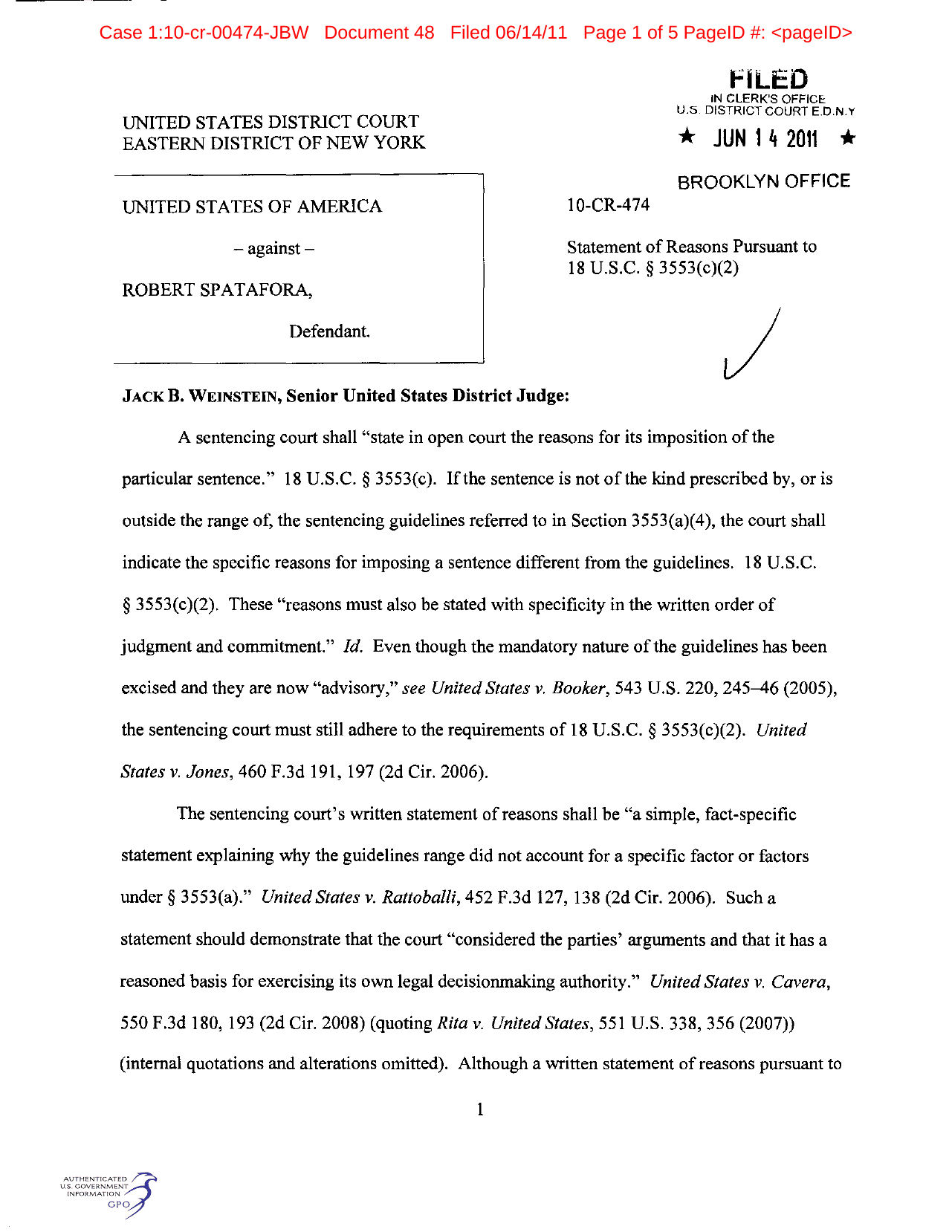
- Sentencing opinion. U.S. v. Spatafora, E.D.N.Y. 10-CR-474, Statement of Reasons Pursuant to 18 U.S.C. § 3553(c)(2), filed June 14, 2011.
- Firsthand role account. Christopher Rizzi supplied the role information used here: lead investigator in the local investigation and wiretap coordinator for the Spatafora wire.
Complex cases still turn on individual evidence.
Royal Palm Investigations supports attorneys with wiretap and communications review, CDR analysis, surveillance, timelines, witness issues, and person-specific evidence mapping in complex criminal and civil matters.