Inside a Gambino and Bonanno Racketeering Case

Inside a Gambino and Bonanno Racketeering Case.
A long-term investigation moved through back-room gambling, extortionate loans, narcotics sales, intercepted communications, surveillance, undercover work, coordinated searches, guilty pleas, and federal sentencing. Christopher Rizzi served as the lead investigator and the surveillance coordinator.
The federal indictment is described as an allegation at the time it was filed. Later facts are tied to the defendants’ guilty pleas and sentencing record. Rizzi’s role is based on his firsthand account of the investigation.
The mob did not disappear. It changed its surroundings.
On Long Island, the alleged enterprise did not announce itself with a movie-style headquarters or a single spectacular crime. Federal records described a quieter economy: poker games, electronic gaming machines, internet sports betting, loans carrying extreme interest, debt collection backed by fear, and narcotics moving through familiar neighborhoods.1
The indictment described a Gambino enterprise operating in Nassau and Suffolk Counties and a Bonanno soldier working with its members and associates. The alleged activity ran from at least 2014 through December 2017. It crossed family lines and moved among different kinds of conduct, but prosecutors presented it as one connected racketeering conspiracy.1
That made the investigation a problem of structure. A gambling debt might look like a private dispute. A cash exchange might look ordinary. A short conversation might mean little by itself. The case became visible only when intercepted communications, surveillance, undercover activity, records, searches, and recurring relationships were placed beside one another.
The federal record identified Ambrosio as an acting captain who supervised loansharking and illegal gambling operations in Nassau and Suffolk Counties.
The federal record identified Salerno as a Bonanno soldier involved in debt collection, gambling activity, and narcotics distribution.
Intercepted calls and undercover evidence placed Saladino in the government’s account of gambling debts, threats, organized-crime affiliation, and cocaine distribution.
The indictment tied Anzalone to the alleged extortionate-credit and cocaine conspiracies.
Damelio and Durso were charged in gambling and drug-related acts. Rodolico was charged in loansharking and obstruction-related acts.
Rizzi served as the lead investigator and coordinated surveillance, helping connect observed people, meetings, movements, and locations to the developing evidence.
The case reflected years of work among the FBI, HSI, Suffolk County Police Department, NYPD, and the Eastern District of New York.
Four years inside an alleged enterprise.
The public record begins with a 24-page superseding indictment and ends with seven guilty pleas and seven sentences. Between those points is the investigative story: how relationships, language, physical observation, undercover activity, records, and enforcement were brought into one federal racketeering case.
In December 2018, the last three defendants stood for sentencing in federal court in Central Islip. Seven men had now pleaded guilty and been sentenced. To understand what brought them there, the story has to move backward—to the debts, games, calls, meetings, and sales that accumulated over several years.
Seven defendants, one racketeering case.
On December 13, 2018, the Eastern District of New York announced the last sentencing in the case. U.S. District Judge Sandra J. Feuerstein sentenced Frank Salerno to 60 months in prison. One week earlier, she had sentenced John Ambrosio to 51 months and Anthony Saladino to 63 months.3
The other four sentences had been imposed earlier that year: Thomas Anzalone received 34 months, Anthony Rodolico one year, and Alessandro Damelio and Joseph Durso two months each. Ambrosio was also ordered to forfeit $100,000, including $66,116 seized from his Huntington residence.2
By then the case was no longer only a collection of allegations in an indictment. Each defendant had entered a guilty plea to racketeering conspiracy, although a guilty plea to that conspiracy did not necessarily establish every predicate act originally alleged against every defendant.
Gambling, credit, debt—and the pressure behind collection.
The federal case placed John Ambrosio at the center of a loansharking and gambling operation. Prosecutors identified him as an acting Gambino captain and alleged that he directed others in extending and collecting extortionate credit. The indictment assigned the broader credit conspiracy to Ambrosio, Anzalone, Rodolico, and Saladino, while a separate act concerning one debtor named Ambrosio, Rodolico, and Saladino.1
The gambling allegation covered a different combination: Ambrosio, Damelio, Durso, Saladino, and Salerno. It described poker games, electronic gaming machines, and internet sports betting operating from January 2014 through December 2017. The indictment alleged an operation involving at least five people that continued for more than 30 days and took in more than $2,000 on at least one day.1
Those activities fed one another. Gambling generated debt. Debt created leverage. Loans carried interest. Collection introduced fear. What might look from the outside like separate private transactions could reveal a hierarchy when investigators documented who directed the work, who collected, where the money moved, and how the same people reappeared across the record.
Watch long enough to understand what the words cannot show.
Rizzi’s position as lead investigator and surveillance coordinator placed him at the junction between the investigative theory and what teams could actually observe. Surveillance had to answer practical questions: Who arrived? Who met? Which vehicle moved? Where did a conversation lead? Did a claimed relationship appear in the physical world?
In an organized-crime investigation, a single observation rarely proves the larger case. Its value lies in sequence. A call precedes a meeting. A meeting precedes a payment. A subject appears at a gambling location. A person known by a nickname is connected to a face, a vehicle, a residence, or a recurring associate. Surveillance gives the communications a setting and gives investigators a way to test their interpretation.
As surveillance coordinator, Rizzi had to translate the case’s priorities into field coverage. Teams needed to know which subject mattered at a particular hour, where observation could be maintained without exposing the investigation, and what detail had to be reported immediately. A vehicle change, an unexpected visitor, or a meeting that began after a call could alter the next assignment.
As the lead investigator, he also had to bring those observations back into the larger evidence picture. Accurate time and location records allowed investigators to compare what a team saw with intercepted calls, undercover activity, known addresses, and later search results. The value was not simply that someone had been seen. It was that the observation could confirm or challenge the working interpretation of the case.
Intercepted words began to explain the relationships.
The indictment release described intercepted conversations about gambling debts, collection efforts, and responsibility within the organization. In one call, Saladino said a debtor would receive “something to be scared about.” In another, Ambrosio told a caller there was no need to travel to a casino because “you can play right here.”1
Other intercepted exchanges described in the public record concerned the movement of gambling money and the collection of unpaid debts. The language could be abbreviated because the speakers shared history. Names could be omitted. Instructions could be implied. Investigators therefore had to identify the speaker, the subject of the call, the debt or event being discussed, and what happened next.
Those fragments mattered because they were not reviewed alone. Investigators compared words with known identities, surveillance, recurring conduct, locations, records, and undercover evidence. Context determined whether a phrase was ordinary talk, exaggeration, instruction, or evidence of an ongoing criminal arrangement.
Twelve cocaine sales gave the case a different kind of proof.
The indictment separated the drug allegations by substance, period, and participant. It alleged a cocaine conspiracy involving Anzalone, Saladino, and Salerno from June 2015 through December 2016; cocaine distribution by Saladino and Salerno during the first seven months of 2016; a marijuana conspiracy involving Durso, Saladino, and Salerno; and an alprazolam conspiracy involving Damelio, Durso, and Saladino.1
Within that larger record, Saladino and Salerno were tied to 12 sales of cocaine to an undercover law-enforcement officer, totaling more than half a kilogram. The indictment alleged a higher total quantity for the broader cocaine conspiracy, while the press release used the undercover purchases to describe the transactions investigators directly documented.1
That evidence did something reputation could not. It created dated events that could be compared with communications, surveillance, the identities of participants, and later search evidence. Each source had limits; together they could corroborate one another.
The case had to show both the network and the individual.
The superseding indictment organized the case around eight alleged racketeering acts, followed by individual counts that restated particular conduct. The acts covered extortionate credit and collection, illegal gambling, cocaine, marijuana, alprazolam, and obstruction. The structure was a map: it showed the alleged enterprise as a whole while identifying which defendants were tied to each part.1
The eighth alleged racketeering act focused on Ambrosio and Rodolico. Prosecutors accused them of trying to obstruct a federal grand-jury investigation by pressuring a loansharking victim to give false testimony. At the indictment stage, that remained an allegation, but it showed how the case extended beyond underlying gambling and debt activity to alleged efforts to protect the enterprise from scrutiny.1
Racketeering cases ask investigators to hold two views at once. The first is wide: the organization, its relationships, recurring activities, money, locations, and methods. The second is narrow: what the evidence proves about one person on one act at one time. Family reputation cannot replace evidence, and association cannot replace conduct.
For the lead investigator, the work meant keeping the developing case coherent without flattening those differences. For the surveillance coordinator, it meant ensuring physical observations could be located in the same chronology as calls, undercover activity, records, and enforcement.
Arrests and searches brought the hidden record into the open.
On December 12, 2017, the 13-count superseding indictment was unsealed. Seven defendants were arrested. The operation brought together federal, county, and city law-enforcement partners after years of investigative work.1
Search warrants were executed at several locations, including a Nassau County storage facility. According to the later plea and sentencing releases, investigators recovered gambling and loansharking records, electronic gaming machines, narcotics, drug paraphernalia, cash, two AR-15 rifles, a .38-caliber revolver, and a sawed-off shotgun.2
The searches also recovered letters addressed to Ambrosio from Bonanno boss Michael “The Nose” Mancuso and former Gambino boss John Gotti. At Ambrosio’s Huntington residence, investigators seized $66,116 that later formed part of his $100,000 forfeiture.2
At the moment of indictment, the charges were allegations and every defendant remained presumed innocent. The searches added physical evidence to the record, but the legal disposition would come through the pleas and sentences that followed.
The indictment became an admitted racketeering conspiracy.
By May 31, 2018, Ambrosio was the last of the seven defendants to plead guilty. He admitted participating in the affairs of the Gambino family by collecting an extortionate loan and supervising gambling that included poker, gaming machines, and sports betting. The six co-defendants had already entered guilty pleas to racketeering conspiracy.2
The pleas resolved the conspiracy charge, but they did not turn every allegation in the 13-count indictment into a separate admitted fact. The final page therefore has to be read in stages: what prosecutors alleged in December 2017, what defendants later admitted, what searches produced, and what the court imposed at sentencing.
The final sentencings that December closed the public chronology. The investigative lesson was larger than the result: a modern organized-crime case had been built by combining human observation, intercepted language, undercover evidence, records, searches, and a disciplined account of how individual acts connected to an enterprise.
What the case taught.
Rizzi’s work as lead investigator and surveillance coordinator developed experience that now applies to complex private investigations, litigation support, criminal-defense review, and contested enterprise cases.
The value is not in claiming that every modern matter resembles an organized-crime prosecution. It is in knowing how to manage complicated evidence without losing chronology, context, or the proof tied to an individual.
Build the chronology before drawing conclusions.
Calls, meetings, movements, records, and transactions become meaningful when they are placed in reliable sequence.
Use surveillance to test the interpretation.
Physical observation can confirm identity, timing, location, association, and whether a communication matches what happened next.
Separate the enterprise theory from individual proof.
A broad theory may organize a case, but every person and allegation must still be tested against the evidence actually tied to them.
Preserve the difference between allegation and disposition.
An indictment states charges. Guilty pleas and sentences establish later procedural facts. The writing should never collapse those stages.
Read the record behind the story.
These four official records show the case at its main public stages: the detailed charges, the public indictment announcement, the final guilty plea, and sentencing.
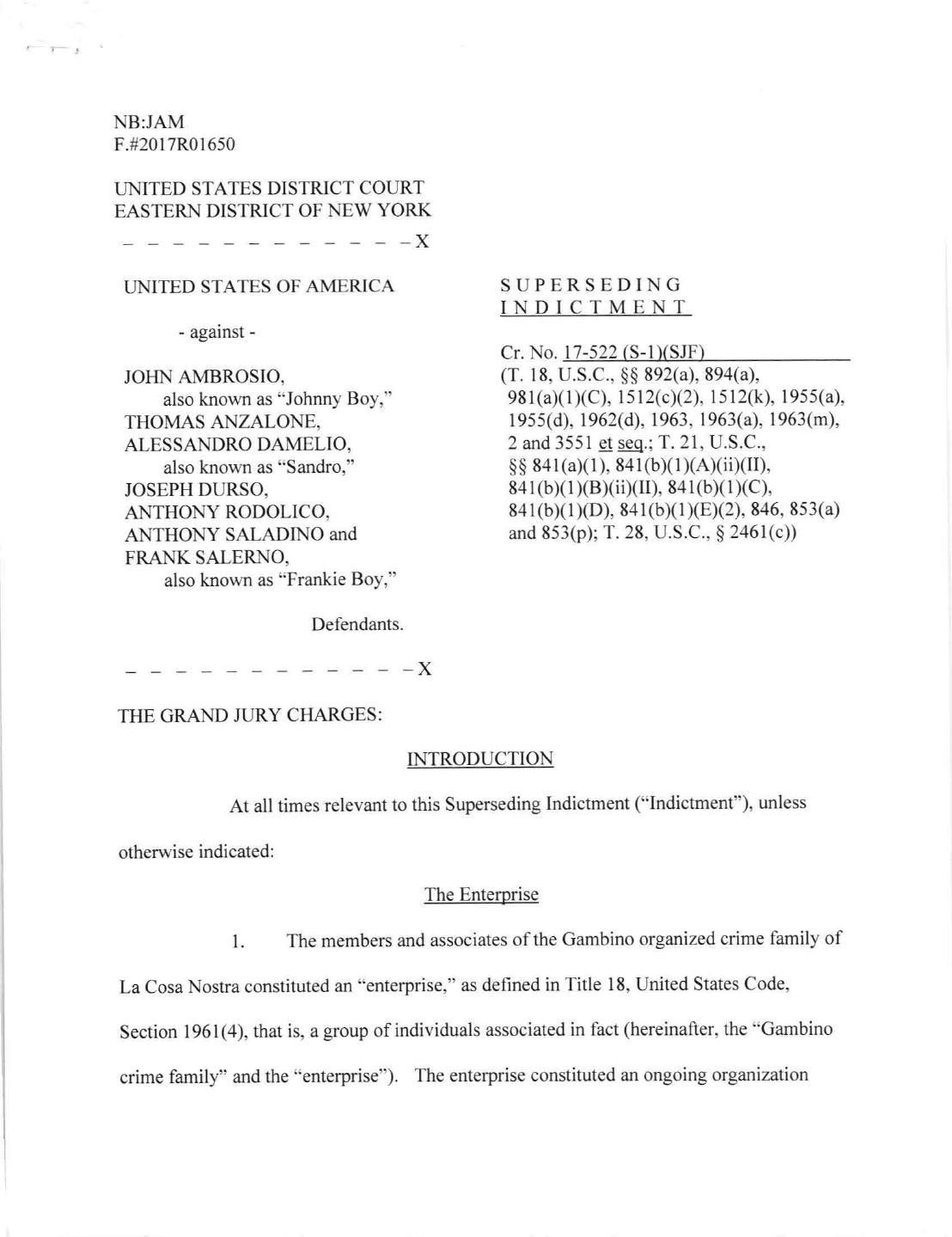
The 24-page, 13-count superseding indictment
The charging document identifies the seven defendants and assigns the alleged racketeering acts and individual counts involving extortionate credit, gambling, cocaine, marijuana, alprazolam, and obstruction.
Seven defendants charged in a 13-count superseding indictment
The release identifies the defendants, alleged enterprise, predicate acts, intercepted-call examples, undercover purchases, coordinated arrests, and presumption of innocence.
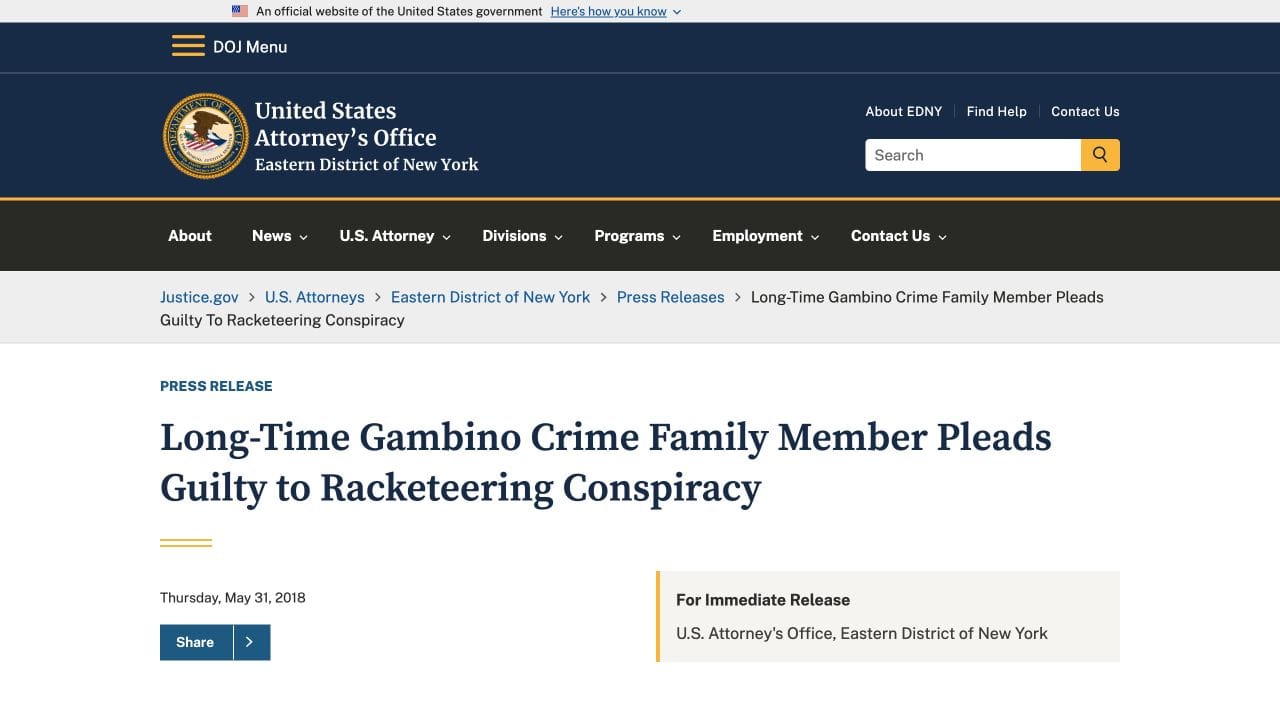
John Ambrosio becomes the final defendant to plead guilty
The release records Ambrosio’s admissions, the six earlier guilty pleas, search evidence, and the $100,000 forfeiture agreement.
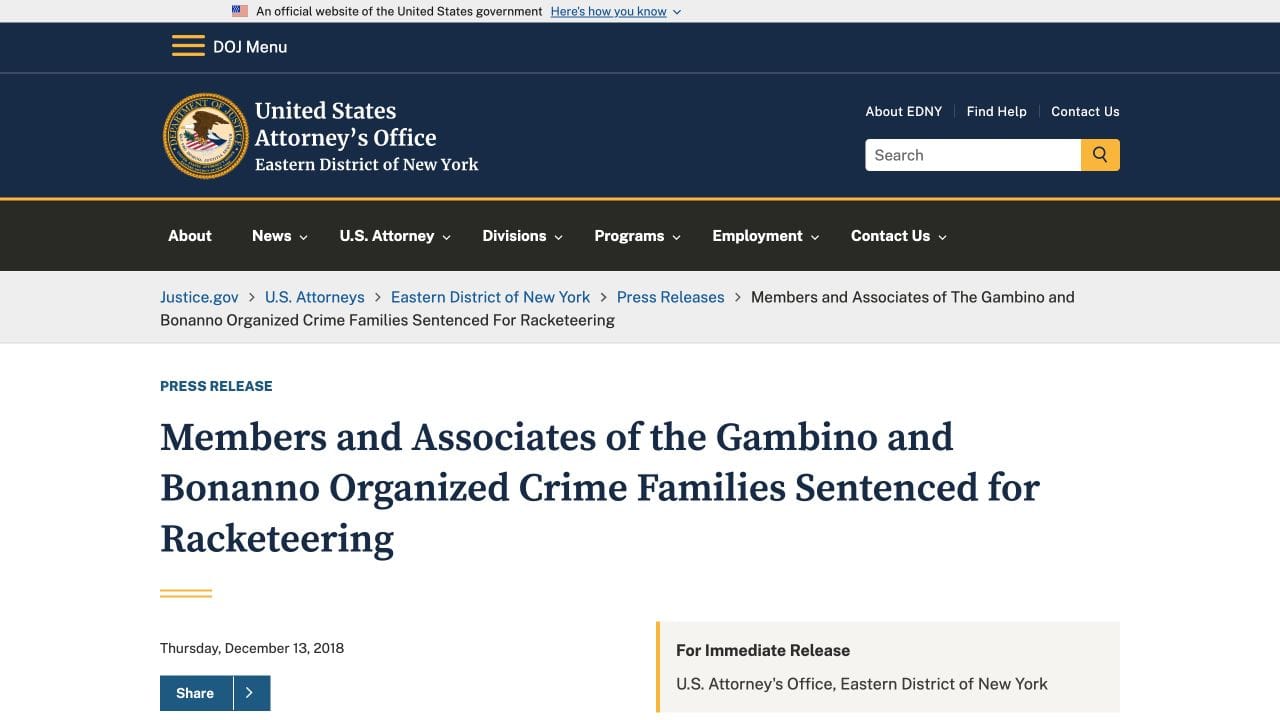
The final sentences close the federal case
The release identifies all seven sentences and summarizes the admitted racketeering conspiracy, intercepted communications, search results, and forfeiture.
What supports each part of the account.
- Indictment stage. U.S. District Court, Eastern District of New York, 13-count superseding indictment in United States v. Ambrosio, et al., No. 17-522 (S-1), and U.S. Attorney’s Office, “Seven Members and Associates of the Gambino and Bonanno Crime Families Indicted for Racketeering and Related Charges,” December 12, 2017. These documents state allegations at the charging stage; the defendants were presumed innocent unless and until proven guilty.
- Guilty-plea stage. U.S. Attorney’s Office, Eastern District of New York, “Long-Time Gambino Crime Family Member Pleads Guilty to Racketeering Conspiracy,” May 31, 2018. This release records all seven guilty pleas, Ambrosio’s admissions, search evidence, and forfeiture agreement.
- Sentencing stage. U.S. Attorney’s Office, Eastern District of New York, “Members and Associates of the Gambino and Bonanno Organized Crime Families Sentenced for Racketeering,” December 13, 2018. This release records the seven sentences and summarizes the case disposition.
- Firsthand role account. Christopher Rizzi supplied the role information used here: lead investigator and surveillance coordinator in the Gambino and Bonanno investigation. The draft does not substitute that account for the official court disposition.
Complex cases are built—and tested—one fact at a time.
Royal Palm Investigations supports attorneys with organized evidence review, surveillance analysis, communications analysis, timelines, and investigative work in serious criminal and civil matters.